Tuesday, January 15, 2013

The Great Ellison-Sutton Migration

John and Mary Ellison Sutton (Maxine Tanner's great-great grandparents) owned a shop in Parr, St. Helens, Lancashire, England.


Their lives changed dramatically when they were baptized into The Church of Jesus Christ of Latter-day Saints on January 12, 1851. Mary's baptismal certificate notes that she was baptized by Elder William Houghton and confirmed the next week by Elder John Bradshaw. They decided to gather to Zion with the Saints. 
In 1853, 2,312 persons emigrated to the Great Basin with assistance from the [Perpetual Emigrating Fund]. Four hundred were in the "poor companies," 1,000 were in the ten-pound class, and the final 955 paid their own expenses. (Arrington, Leonard J., and Davis Bitton. The Mormon Experience: A History of the Latter-Day Saints. New York: Knopf, 1979, 131.)
The Suttons were among these emigrants. I cannot tell what the money amounts mean in the Perpetual Emigrating Fund record (see below), but I assume the Suttons paid their own way, since they also helped two young men and a number of families to emigrate:
Here are the PEF records showing the emigration arrangements.


After coming to America, the Suttons had some assets but were not wealthy, according to the 1860 United States Census.


From comparing their stated Value of Real Estate and Value of Personal Estate with others in Nephi, Utah, it looks like they probably had a small but sufficient home and an average amount of personal wealth (see definitions here). But they also had another kind of wealth: they lived surrounded by their children and relatives as well as some of the families they'd helped bring to America.

When John Sutton died in 1865, his obituary said:


Here is a chart Mary Ann Linton Morgan drew, showing the descendants of her grandparents John and Mary Sutton.

Monday, January 14, 2013

The Well-Traveled Tanners

Wallace Tanner, 1970s passport picture.

Wallace and Maxine Tanner liked to travel. Here are some of the visas from two of Wallace Tanner's passports.

Japan, 1975.

Friday, January 11, 2013

LeRoy Tanner Pictures and Documents

Since the blog has had a military theme recently, here are some additional documents about LeRoy Parkinson Tanner, including some from his service in the First World War, and a picture.

This picture is called "Tanner Family with Leroy holding Wallace." Except for those two named (the man standing near the right of the photo with a small boy in his arms) I don't know the identities of any of the others. I suppose they're Roy's brothers or sisters and other relatives in Joseph City, Arizona.


This is an Enlistment Record with corrections. LeRoy's military service has been mentioned previously here (Veteran's Day; a collection of his American Legion cards) and here (LeRoy Parkinson Tanner Military Service).


Tuesday, January 8, 2013

The Green Mountain Boys: David Shepherd and Waite Hopkins in the Revolutionary War

On this blog, I've rarely gone back beyond the generation that joined the Church because there's so much information to cover in the closer generations, but since I'm on the topic of the Shepherd family and military service, here are a few notes about some of the ancestors on this line who fought in the Revolutionary War. They were from Vermont, so they were part of Ethan Allen's militia, the Green Mountain Boys.

The flag of the Green Mountain Boys.

Monday, January 7, 2013

Henry Tanner: Joseph City Arizona Pioneer

My dad sent a link to a digitized copy of George S. Tanner's Henry Tanner: Joseph City Arizona Pioneer. You can download it here:
Henry Tanner: Joseph City Arizona Pioneer
Here's the first page:


And a random page with the end of one interesting story (found here), and two others in their entirety:


Saturday, January 5, 2013

A Christmas Surprise: The Danish Missionary

For Christmas this year, my husband had a print framed that I purchased many years ago and have been storing ever since. This picture is now on the wall of our living room. The Ovesens were carpenters before and after coming to America, so they would have been familiar with scenes such as this one.


The picture is an Arnold Friberg copy of a painting by the Danish Romantic painter, Christen Dalsgaard. The painting is called Mormoner på besøg hos en tømrer på landet [Mormons visit a country carpenter] (1856). The original is in the Danish National Gallery.

Copy of the picture from Wikipedia. Cross-posted at The Diary of Ove C. Oveson.

Friday, January 4, 2013

Samuel Shepherd and the War of 1812

Samuel Shepherd's Prisoner of War record. U.S. Vols Militia Rifleman, War of 1812. As you can see from the crossed out "Confederate," this record was created after the Civil War.


Next is the page 27 mentioned in the first record:

Account of Cloathing delivered the Volunteer Militia Riflemen in the ? in ? the United States, under Command of Col. Isaac Clarke near Lake Champlain, Prisoners of War in Canada. by Robt Gardner Agent &c.


Records of Men Enlisted in the U.S. Army. Shepherd Samuel [Shepard] Priv. Vt ?, Capt. W. Gates. Height 5 feet, 11 1/2 inches, Eyes Blue, Hair Lgt., Complexion Lgt., Age 21, Occupation Farmer., Guilford, Windham, Vermont. Enlistment Feb. 23/[18]10, Niagara, Capt N. Leonard, 5 yrs. D. R. Feb. 16/[18]15. present ? Ft. Independence Feb 28/[18]15. Discharged Feb. 23/[18]15.


Samuel's pension filed for his widow Sarah Whitney Crandall Shepherd. It shows service in Capt. Asel Scovil's Co., Vt. Mil.


Other records can undoubtedly be found and ordered from the National Archives. The family histories also preserve a few memories of his service.
As Samuel grew up he heard many heroic stories of the Revolutionary War. His father David fought in the war as did his grandfather The Reverend Wait Hopkins who was killed in battle in 1779. So it was no surprise when Samuel and his brother Henry enlisted to fight the British in the War of 1812. Records indicate that he fought in a Vermont Regiment under Colonel Martindale, Captain Ashael Scovell and Captain David Sanford. Samuel was taken prisoner of war in 1813 and held in a British prison in Canada for several months. Samuel told his grandchildren tales of the war including his imprisonment. His granddaughter Sarah Shepherd Maeser wrote,
I remember hearing him tell, jokingly, that the cell in which he was confined was so filthy and his clothes so full of “cooties” that he could put them [the clothes] at one side of the cell and go to the other side and whistle and his clothes would come crawling over to him.

Thursday, January 3, 2013

The Shepherd and Crandall Families and the Great Journey from East Coast to West Coast


This post is originally from May 19, 2008. I have been updating it with a lot of new information.

Here's the updated version.

* * *

I realized that I didn't have Samuel's third wife listed in his biographical information. Her name was Sarah Whitney Crandall. Her first husband was Simeon Crandall. 

Here is some information about the Crandall and Shepherd families.


* * *

Simeon and Sarah Whitney Crandall were originally from New Paltz, New York.

They moved to Ohio by 1818 and according to their family records lived in Chagrin, the same town as Samuel and Roxie Shepherd.


Actually, the 1830 Ohio census places them in the little town of Mayfield (population 333) with several other families named Crandall. Both towns are close to Kirtland.


The Crandalls joined the Church of Jesus Christ of Latter-day Saints in 1830, and the Shepherds in 1832. Simeon and Sarah Crandall had ten children; Samuel and Roxie Shepherd had eight children. On the way to Missouri, Roxie died. Later, Samuel married widow Charity Bates Swarthout. Besides Charity’s seven children, Samuel and Charity had one additional daughter.

After settling in Utah, Samuel and Charity Shepherd and Simeon and Sarah Crandall moved to San Bernardino and ended up spending most of the rest of their lives there.

In 1870 Samuel and Charity were baptized into the Reorganized Church of Jesus Christ of Latter-Day Saints (now Community of Christ) by J.W. Gillen. Simeon and Sarah Crandall had joined the RLDS church in July 1864.

In 1871 the United States government granted pensions to war veterans. On 28 March 1871 Samuel appeared before the clerk of the district court to record his service in the War of 1812 and receive a pension.

Simeon Crandall died April 23, 1872.

Charity Shepherd died in 1877 at the age of 83. One month afterward, the Reverend A. Whitlock [probably Alma Whitlock, the son of Harvey G. and Minerva Abbott Whitlock] joined Samuel Shepherd and and Sarah Whitney Crandall in marriage.

After Samuel died a few months later, Sarah filed for a pension in Samuel’s name.


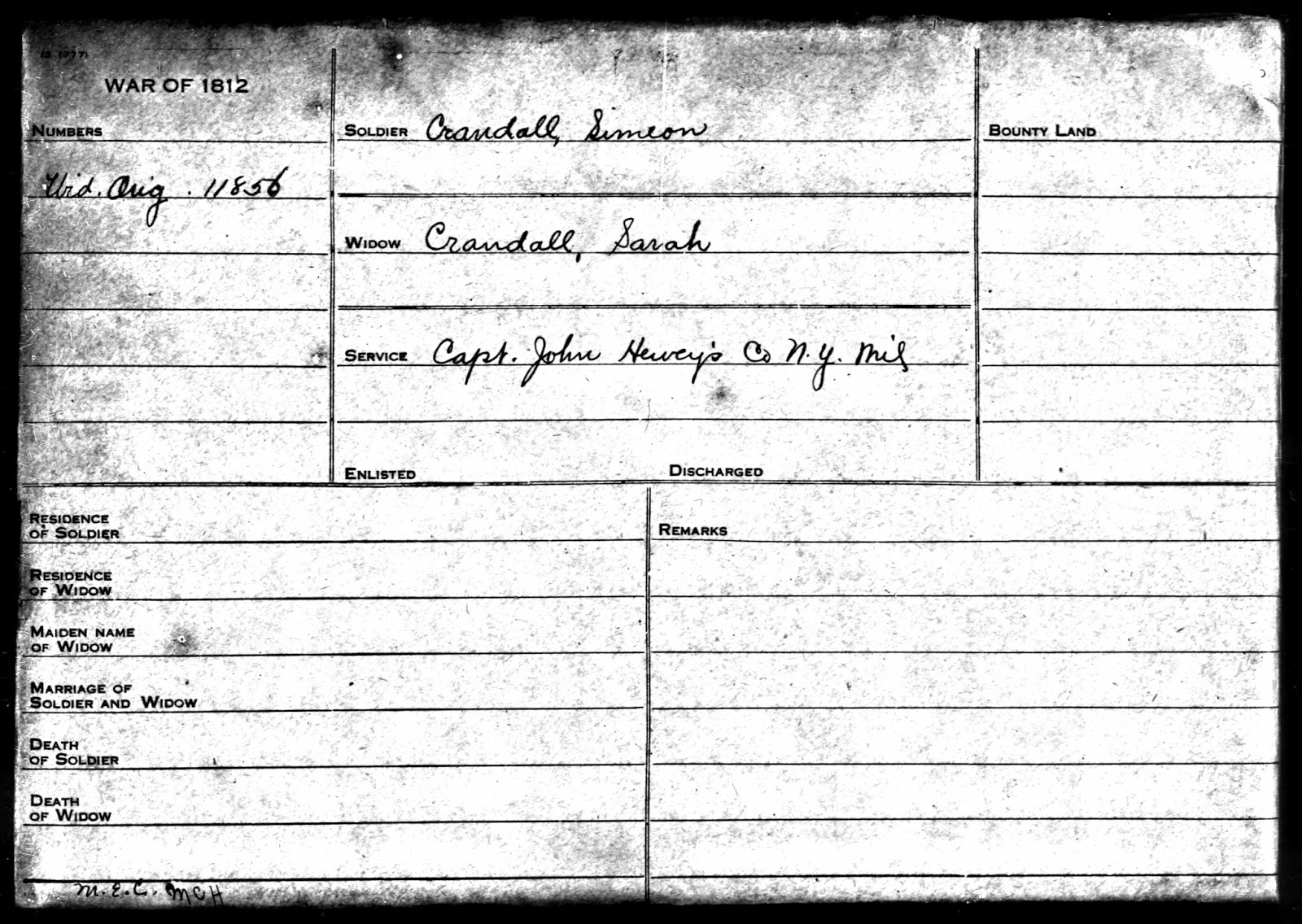
Sarah had previously filed for a pension due to Simeon's service in the War of 1812. I assume this is noted in the coding to the left of the pension record above.


I don't know when Sarah died. Some family records say it was 1870, but that is not the case. Sarah Shepherd shows up in the 1880 United States Census living with her son Charles Crandall.


Some of the Shepherd and Crandall children stayed in the Church. At least one of the Crandall children is buried in the private Kimball-Whitney Cemetery in downtown Salt Lake City and Crandall descendants have names like Kimball, Young, and (of course) Crandall.

Samuel and Roxy have thousands of descendants in the church, mostly in the Marcus deLafayette Shepherd and Julia Ann Shepherd Tanner lines.

* * *

I found enough interesting information about Samuel Shepherd's service in the War of 1812 that I'll put it in a subsequent post.

* * *

The picture of the Joshua tree is from Wikipedia. Tradition says that Mormon pioneers (meaning our ancestors) crossing the Mojave desert between Utah and California gave Joshua trees (Yucca brevifolia) their common name because the plants reminded them of the Bible story where Joshua lifts up his hands to stop the sun.

Wednesday, January 2, 2013

John Morgan's Military Service: Indiana or Illinois?

Everything I've read about John Morgan's service in the Civil War places him in the 123rd Illinois Infantry. I just saw a source the other day which was a bit confusing. This is a record called "Veterans with Federal Service Buried in Utah, Territorial to 1966," and it lists his enlistment as December 14, 1863 in Rush Co., Indiana, and his regiment as Co E, 123rd Inf.


I would have assumed that this record was accurate — why wouldn't it be? — but this is a case of "don't believe everything you read." The John Morgan who enlisted in Rush County on December 14, 1863, was a John F. Morgan from Richland, Indiana, who belonged to the 123rd Infantry Regiment Indiana, Company E. (See the company roster.)

Our John Morgan served in the 123rd Infantry Regiment of Illinois, Company I.


Here is his entry in the company record. It is the last one on the top page. It shows that he was from Mattoon, Coles, Illinois, that he enlisted on August 1, 1862, that he was mustered in on September 6, 1862, and that he mustered out on June 28, 1865 as a sergeant. 
Reece, Jasper N., and Elliott, Isaac Hughes, 1837-1922. Report of the Adjutant General of the State of Illinois, Vol. 6. Springfield, Illinois:Journal Company, Printers and Binders, 1900, 412. (Link.)
Here is another record I saw, John Morgan's entry in the 1890 Census of Union Veterans and Widows of the Civil War (Utah).


The reason I looked up these service records is because I am a Boy Scout Merit Badge Counselor, and I was doing the Citizenship in the Nation merit badge with my two sons yesterday. As part of one of the required discussions, I decided to pull out my biography of John Morgan and read them from some of his letters including the following excerpts:

Tell Pa that I wish I was home to help him but as long as there is an armed foe to my country at large, I will be found in the ranks of the Patriot army. It is getting late and I must close. (Letter to his mother, as edited in The Life and Ministry of John Morgan, 17.) 
It makes me a little riley to hear of good staunch administration men turning from their allegiance to their Government and supporting on of the most God forsaken projects (as the present Peace Party claims to be) that was ever invented. 
Were it possible I would wish that Lincoln could assume the power of a dictator for 12 months and would hang every man that dared utter one word in favor of the rebellion or peace.
Congress and Northern Legislatures and northern traitors are doing more for the cause of the Rebellion than all the Southern Army: they are discouraging the Federal Army and encouraging the Rebels as much as lay in their power. 
We of the army are in for nothing but the subjugation or annihilation of the South and if we cannot accomplish it in three years we can in six but that it can be done we are satisfied and that we are the Army that can do it we are also satisfied. 
I am in as good health as I ever was in my life. My back is as strong as all outdoors. I can march 25 miles in a day—drink 2 pints of coffee; eat some fat pork and wrap myself in a blanket and sleep sounder than I ever could at home. (Letter to his father, also edited in The Life and Ministry, 11.)
For more information on John Morgan's Civil War service, see the military posts listed in Important John Morgan Posts, and the information on Bessie's blog including John Hamilton Morgan (1842-1894) and his son, John Hamilton Morgan (1894-1982).