Monday, April 29, 2013

Gems from the Overson Collection of Photographs

One of the benefits of digitizing the huge Overson Collection of Photographs are the surprises. Here are two classic photos taken on 26 March 1911 at the home of George and Ann Prior Jarvis in St. George, Utah.
The caption reads,  "Grandfather George Jarvis, age 88 yrs. and one day; Annie P. Jarvis, age 81 yrs., 3 months, Mar. 26, 1911. C.S.J. , St. George" This picture does not appear in the Jarvis book. (Overson, Margaret Godfrey Jarvis. George Jarvis and Joseph George De Friez Genealogy. Mesa?, Ariz: M.G. Jarvis Overson, 1957).

This picture is cropped on page 49 of Jarvis book. The caption says "George and Annie P. Jarvis and George F. Jarvis and Anna Jarvis Ward and children. Mar. 26, 1911 C.S.J."

George Frederick Jarvis was their first child, born 16 June 1847 in London, Middlesex, England. The lady named Anna Jarvis Ward is likely Anna Catherine Jarvis, the fifth child of George Frederic and Eleanor Cannon Woodbury Jarvis. Anna was born 5 July 1882 in St. George, Washington, Utah and married William F. Ward on 20 May 1903. The three children are likely her first three: Eleanor Ward, born 29 March 1905, Frederick Jarvis Ward, born 7 May 1907 and Catherine Ward, born 14 March 1909. They appear to be about the right ages.

Friday, April 26, 2013

The John Tanner Family Mayflower Connection — Part One


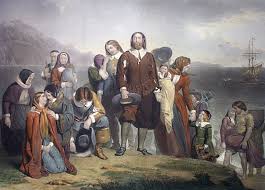
It is a tradition among the descendants of John Tanner that they have ancestors who came to America in 1620 on the Mayflower. It happens that the tradition is correct, but I would guess that few of the descendants could name the passengers and even fewer could explain how they are related. I propose to give some of the background of the Mayflower passengers and more particularly, those from whom the Tanners are descendants. 

The Mayflower passengers were not among the first Europeans to visit the American continent. They missed that opportunity either by 128 years or hundreds of years depending on which history you would like to believe. Theirs was not even the first European settlement.[1] The first permanent European settlement in the continental United States was at St. Augustine, Florida in 1565.[2] The Mayflower passengers did not even settle in the first British colony. That honor goes to the settlers on Roanoke Island off the coast of what is now North Carolina in 1585.[3] That settlement failed, but a successful one was established in 1607 at Jamestown. [4]

So what is the significance of the Mayflower passengers? Other than black hats, Indians and turkeys, what do we really know about these early settlers and why are they significant? Perhaps the answer lies, in part, in the place where they settled, Plymouth Colony in what is now Massachusetts but was then considered the northern part of Virginia. Rather than the temperate coast of North Carolina or the semi-tropic climate of Florida, the Mayflower passengers landed on the northeast coast, a cold and stormy place with rocky soil. 

But the story of the Mayflower passengers is vastly more complicated than any present-day apologist or religious detractor would have you believe. We often refer to these original settlers as "Pilgrims" and this designation has taken on a quasi-religious flavor. But, of the 102 original Mayflower passengers, only 41 came to America as religious refugees; the remaining 61 passengers came for purely economic reasons.[5] The "Pilgrims" as all of these passengers have come to be called were English "separatists" who separated themselves from the Church of England and the rule of King James because they found the practices of the Church to be corrupt and in conflict with the Bible. They originally left England for Amsterdam and Leiden where they lived for 12 years before leaving for the New World. 

Much of our first-hand information about these early settlers comes from the journal of William Bradford in a book he later published called Of Plimoth Plantation. The manuscript of Bradford's journal was not published until 1856.[6] The book is generally available in its original format with no corrections for spelling or grammar as an ebook. 

See Bradford's History Of Plimoth Plantation from the original manuscript.[7] Bradford’s manuscript contains a list of all the Mayflower passengers and subsequently, it is only those who are descendants of those passengers who are eligible to apply for membership in the Mayflower Society (General Society of Mayflower Descendants).[8] On that list are the names of three passengers who have been proven to be ancestors of John Tanner: Francis Cooke, John Cooke and Richard Warren.

Part of the significance of the Mayflower passengers and their settlement at Plymouth Colony is a document they drafted to attempt to avoid conflict between the Pilgrims and their fellow travelers. This document is now known at the Mayflower Compact and is considered one of the first steps taken in the New World that culminated in the drafting of the United States Constitution.

Thursday, April 25, 2013

Johan Bengtsson Wessman in the Swedish Church Census

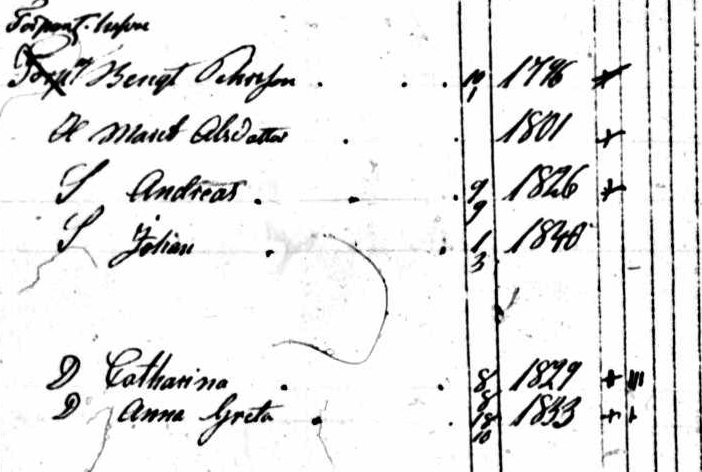
The Swedish Lutheran Church kept a variety of Church records including a church census showing all members of each parish (Husförhör), and records of anyone moving in (Inflyttning) or out (Utflyttning) of the parish. Here are the Husförhör.

Johan was born in 1840. Here is the record of Romelanda Parish, Braseröd Farm, 1837-1842.  There were a number of families living on the farm. This record shows a tragic time in the family, followed by a big change.


Farmer Mr. Bengt Pehrsson [born] January 10 1796
Mrs. Inger Ambjörnsdotter [born] January 12 1797 [the cross-out means she died]
Mrs. Maret Olofsdotter [born] 1801
Son Petter [born] Sept. 16 1821 Moved out    Son Gustaf [born] November 1823 Moved out   Son Andreas [born] September 9 1826
Son Johan [born] March 1 1840
Daughter Catharina [born] August 8 1829
Daughter Anna Greta [born] October 18 1833
Illegitimate step-daughter Borta [born] February 8, 1824 Moved out[Illegible] [Illegible] Bengtsdotter [born] Dec 13 1824    Inger [illegible] [born] 18-1
The three children who moved out should show up in the Utflyttning, which we will look at next. Also of interest in this census are the following records of two of the witnesses (godparents) from Johan's christening:


Romelanda Parish, Braseröd Farm, 1842-1844


Farmer [he changed status from one type to another during this time period, but I don't recall the difference] Bengt Pehrsson January 10 1796
Mrs. Maret Olsdotter 1801
Son Andreas September 9 1826
Son Johan March 1 1840
Daughter Catharina August 8 1829
Daughter Anna Greta October 18 1833

Romelanda Parish, Braseröd Farm, 1845-1850
The family is not at Braseröd Farm anymore. They may be elsewhere in the parish, since their entries from 1842-1844 don't indicate a move out of the parish. The census is 124 pages long, so I will have to look through it another time, as well as looking at the move-in and move-out records.

Wednesday, April 24, 2013

Johan Bengtsson Wessman Birth Record

Amanda and Johan Wessman and child.
With the unexplained discrepancy in the ages of Johan Bengtsson Wessman's grandparents from Monday, I am starting again from scratch to make sure that all the families have been assembled correctly.


Swedish birth and christening records have been kept since 1686, when a church law stated that each parish priest must keep records for "All children legitimate as well as illegitimate with their parents and godparents names (and the) birth and christening date." [Source.] The records are not always available due to church fires and other circumstances, but families can also be reassembled using other church and government records.

When looking at birth records, the best way to make sure you have the correct person is by using a combination of names, places, and witnesses, since you can't tell from names alone. Since personal names in Sweden were taken from a fairly small set of names, it was not uncommon to have two children of the same age in the same parish with the same name, and I've seen families in the same parish where the husbands and wives have the exact same names and were having children at the same time.

So, let's start with Johan Bengtsson Wessman's birth record. He was born at Braseröd in Romelanda Parish, Göteborgs och Bohus, Sweden, on March 2, 1840. Romelanda Parish is now called Diseröd and from time to time records will be indexed under that name.

This is the church where Johan was christened when he was two days old.

Romelanda Church, looking much as it did in 1840. From Wikipedia.

Here is the Romelanda parish record book for 1840 to 1880. This book was scanned by the Genealogical Society of Utah (now FamilySearch) in 1956. The record is available from the Church on microfilm, or from Ancestry.com in digital format.


Here is the page showing Johan's birth and christening record. His name at birth was Johan Bengtsson. He later changed his name to Wessman.


Here is a close-up of his record.


1840 Births and Christenings in Romelanda Parish...
Entry 11. [March]. Born: 2. Christened: 4. Name: Johan. Parents: Bengt Pehrsson from Braseröd, Mrs. Maret Olsdotter. Age of mother: 39. Witnesses (godparents): Telle Oleson from Braseröd, Arvid Andreasson from N. Esphalassen, Catharina Nilsdotter from ___, Anna Britta Larsdotter from Signahög.
The next record created for a child would be the communion records. Romelanda communion records only cover the years 1812-1831, so they will not include Johan.

Next up is the Romelanda clerical census and the Utflyttning register. When I look up the family in the census, I will also check the place names shown in the birth/christening record to make sure they're correct.

Johan is the first person shown on this genealogy fan chart, in green. His parents, Bengt and Maret, are shown in blue.

Tuesday, April 23, 2013

Research on the Johan Bengtsson Wessman Family in Sweden


I realized yesterday morning that I am going about the presentation of the Wessman genealogy in a haphazard fashion. What I am doing is adding my previous research to FamilySearch Family Tree, and noting records as I see them. It can't make much sense to someone unacquainted with the family, though, so here's an attempt to make sense out of the many records and families.

Here's the Wessman family fan chart from a couple of weeks ago:


Most of my work has been on the left half of the chart (Johan's family), so here's a version of just that half:


I'll post this fan chart every time I present research and note which family is being described. I added this chart to yesterday's post.

A Few Notes About Swedish Research

Here is the Sweden page in the FamilySearch Wiki. It's still in progress, but it has some links to some good resources. The article "Finding an Unknown Father" is particularly good. 

Here is a simple guide to Swedish research: Your Guide to Researching Swedish Ancestors.

After I returned from my mission, I felt like I should learn Swedish, and I registered for a Swedish class, but the instructor was very young and was trying to teach by total immersion, which wouldn't work for my needs which would consist of reading and possibly writing Swedish, but rarely speaking it, so I dropped the class and have regretted it ever since. So until I go back and learn Swedish, I use lists of genealogy terms:
The picture of the Swedish-Norway border just north of the area where the Wessman family originated is from idleformat at Flickr and is used under a Creative Commons license.

Monday, April 22, 2013

Anna Bengtsdotter of Östra Berg, Hjärtum, Göteborg och Bohus, Sweden

A couple of weeks ago we saw the birth record for Pehr Andersson. (Also "Per.")

Pehr (or Per) and his wife Anna are Johan Bengtsson Wessman's paternal grandparents, so they are shown to the left in the red part of this  family fan chart.

I'm going through these records for the first time in years and am wondering why Anna is twenty years younger than Per, and he doesn't show a prior marriage in the family records. Statistically, there should be either be a prior marriage or another reason for the late marriage, such as military service, or there's a possibility that we are looking at the wrong family. I will keep looking through the records, including the church census, and build a case for this being the right family, looking first at the birth of our ancestor Bengt Persson, and building the family around him.


But here is the birth record I currently have for Anna Bengtsdotter.

Year 1775. January. 30 December 1774 born and 1 January christened. Bengt Torstensson and Anna Andersdotter, baby girl from Östra Berg [Hjärtum], named Anna. 
Witnesses: ___ Anders Olofsson from Östra Berg and Olof Mansson from ___, Gunnur Torbionsdr from ___ Bordag. Mrs. Malin Andersdr from Mullnyröd.
And here is the marriage record I previously identified for Per Andersson and Anna Bengtsdotter.

[Västerlanda Parish, 1792 October] 28 ___ and ___ ___ Per Andersson from Rösebÿu in Forshella ___ ___ Miss Anna Bengtsdotter from Vesterlanda ___.
Anna was born at Östra Berg, a place which shows up in the earliest church census of Hjärtum (1792), but which does not seem to exist now, and unfortunately I have not been able to figure out the technical details to see the historical maps of Sweden, since I'm still trying to determine which Mac browser will work with a djVu plugin.

This map shows (A) Hjärtum, where Anna was born, to (B) Västerlanda, the place where she was married in 1792. The parishes are six miles apart.

Friday, April 19, 2013

The Tanner Family Daguerreotype: Conclusion


Like I said in March 2012, since there was no identifying information included with this daguerreotype, we will probably never be 100 percent sure of the identifications. It has been accepted by many descendants as a picture of John Tanner, and I respect the effort that went into that conclusion, but as much as we would all like this to be a picture of John Tanner, it isn't.

The picture was kept in the Myron Tanner family because he is the man at the left. This picture would have been taken after Myron arrived in San Bernardino in the fall of 1852 following his successful California gold mining adventures.[1] He would have had cash in hand to pay for the fairly expensive picture and case.


Myron is Elizabeth Beswick Tanner's oldest son and is sitting at the right hand of his widowed mother who, like her step-daughter Louisa Maria Tanner Lyman, seems to be wearing mourning, either to mark the death of her husband John Tanner in 1850 or the death of her daughter Sariah Tanner in March 1853. Myron would have been 26 or 27 at the time this picture was taken.


The boy standing behind Elizabeth is her son Joseph Tanner, 19 or 20 at the time. [See comment below; Linda Davis made a compelling argument on FamilySearch in 2019 that the boy in the back is David Dan Tanner rather than Joseph.] Both Myron and Joseph [and David Dan] have distinctive Beswick features, most notably the mouth, but also an easily recognizable spacing of their facial features, and both men hold their heads at a particular angle in the pictures.

My final identification of the subjects of the daguerreotype:
Sitting, left to right: Myron Tanner, Elizabeth Beswick Tanner, Louisa Maria Tanner Lyman. Standing: Joseph Tanner [David Dan Tanner].
I would be happy to hear reactions to this series. Do leave a comment. If you disagree with the identification, please read through all the posts and let me know what part of the data you interpret differently and why. If you have questions about my sources, just ask, and I'd be happy to provide further citations.[2]

Analyzing this daguerreotype has been a great adventure. The existence of the picture, kindly provided to the Tanner family by way of the Church History Library by Myron Tanner descendant Claudia Rayl, together with the recent movie Treasure in Heaven, has led to a resurgence of interest in the Tanner family history. What a wonderful time for the John Tanner family.[3]

Notes
[1] Myron's biography states that he left Utah Territory for California in the spring of 1850, several months before any daguerreotypist was known to have been operating in Salt Lake City, so 1852 is the first date a daguerreotype could have been taken, and the family was in California at the time.

[2] Although I sometimes link to articles in Wikipedia, that is because the links tend to be stable and quickly explain the subject. I have a degree in history and specialize in community and family history, and I have been trained by excellent historians, so the information contained in these posts is from a large variety of vital and census records, primary and secondary sources, and one well-written, well-sourced Wikipedia article on hand-colored photography. My bibliography for this project is currently seven pages long, and it would be overkill to post it here, but as said, I would be happy to answer questions about sources and citations.

[3] To anyone who is reading this far down the page, I would suggest that any efforts to gather and write more of the history of the family should include the stories of the women, since the family history efforts up until now have almost exclusively focused on the Tanner men.

[May 29, 2014. A claim was made elsewhere that the subjects in this daguerreotype had to sit still for twenty minutes for the exposure. I'm not sure where that information came from. The following creditable source notes that by 1842, exposure time was down to as little as ten seconds. (The Daguerreotype Process.)]


Links to Posts in the Tanner Family Daguerreotype Series

Tanner Family Daguerreotype: Response from CHL


The other day I noted that I would post the response from the Church History Library in Salt Lake City about the daguerreotype case. Here is the entire response, with two pictures sent by the reference librarian.
Our response is:
After examination by our archive administration we conclude that there is no evidence of fire damage (see attachment). Best wishes with your project.

Number of documents attached to this message:2
Attached documents may be listed at the beginning or end of this email

Sincerely,
[...]
Reference Librarian
Church History Library

The status of your question is now closed.

Thursday, April 18, 2013

The Tanner Family Daguerreotype: Man at Left — Options

The Man in the Daguerreotype
The daguerreotype was either taken in 1844 in Nauvoo, 1850-51 in Utah Territory, or after 1852 in California. To give a pretty wide range, he seems to be over 20 and under 60, so he would have been born between 1784 and 1832. These are the men in the Tanner family who may fit the bill.

John Tanner (1778-1850)
There is no known picture to compare.

Elisha Bently Tanner (1801-1858)
Son of John and Tabitha Bently Tanner. There is no known picture to compare. There is no indication in the family history that he ever visited the West.

William Stewart Tanner (1902-1875)
Son of John and Lydia Stewart Tanner. Note that the picture says "Stuart." That's a late-nineteenth century affectation by the Tanner family in the west. The correct spelling is Stewart, as used by his mother's family and in his 1875 Massachusetts probate.

Sidney Tanner (1809-1895)
Son of John and Lydia Stewart Tanner. Accompanied the family to the Nauvoo area, Utah Territory, and California.


John Joshua Tanner (1811-1896)

Son of John and Lydia Stewart Tanner. Accompanied the family to the Nauvoo area and Utah Territory. Did not go to California.

Nathan Tanner (1815-1896)
Son of John and Lydia Stewart Tanner. Accompanied the family to the Nauvoo area and Utah Territory. Did not go to California.


Martin Henry Tanner (1822-1907)
Son of John and Lydia Stewart Tanner. There is no known picture to compare.

Albert Miles Tanner (1825-1879)
Son of John and Lydia Stewart Tanner. Accompanied the family to the Nauvoo area, met them in Utah Territory after serving in the Mormon Battalion, and went with them to California.

Myron Tanner (1826-1903)
Son of John and Elizabeth Beswick Tanner. Accompanied the family to the Nauvoo area, met them in Utah Territory after serving in the Mormon Battalion, and met them in California after joining the Gold Rush.

Seth Benjamin Tanner (1828-1918)
Son of John and Elizabeth Beswick Tanner. Accompanied the family to the Nauvoo area and Utah Territory, and met them in California after joining the Gold Rush.


Freeman Everton Tanner (1830-1918)
Son of John and Elizabeth Beswick Tanner. Accompanied the family to the Nauvoo area, Utah Territory, and California.


Joseph Smith Tanner (1833-1910)
Son of John and Elizabeth Beswick Tanner. Accompanied the family to the Nauvoo area, Utah Territory, and California.


David Dan Tanner (1838-1918)
Son of John and Elizabeth Beswick Tanner. Accompanied the family to the Nauvoo area, Utah Territory, and California.

The Boy in the Daguerreotype
Just for the sake of comparison, here is the boy in the back. 

* * *

And now I have given everyone all the information necessary to identify the people in the picture. Anyone want to make a guess before I reveal my final identification tomorrow? No credit for the identity of either of the women — we already know who they are — but the first people to match my conclusions on the identity of either the man or the boy will receive a certificate for meritorious genealogical efforts. The first person to come up with both of them will receive a certificate for meritorious genealogical efforts and bragging rights. :)

Here are links to all the posts if you want to check any of the clues or data.

Links to Posts in the Tanner Family Daguerreotype Series