Wednesday, June 29, 2011

Memories of Henry Green, Part 4 of 4


A Tribute to Grandpa

By Marilyn Green Lund

It is a great pleasure to reflect back upon my early childhood days, and my visits to Grandpa’s home, seeing his ready smile and loving welcome. They are very pleasant memories to recall.

Many times in later life I have thought how very grateful I am for having known Grandpa, as not many children are blessed with “living” grandparents. I’ll always remember the love and concern he had for his family as well as for others. As young as I was, this was most evident to me.

I can still see everyone around the dining room table for special family dinners, and the laughter in the living room where all the cousins were gathered playing, or singing around the player piano, and the fun we had in the attic playing dress-up and games. This seemed to make Grandpa happy too.

All in all, they were and still are most pleasant memories of my days at Grandpa’s.


———


My Remembrances of Henry Green

By Lucy Green


One of my very nicest remembrances of Harry’s father (I called him father always) is that whenever he greeted me he always put his arms around me and kissed me on the cheek and said, “Lucy we love you!”

As the English are noted for their “cup of tea” Father came to our house on Emerson Avenue on several occasions unannounced at lunch time and if I wasn’t prepared for anything special he would say it would be nice to have just a piece of toast and a cup of tea which we had together in our very small breakfast room and he would reminisce about old times.

Tuesday, June 28, 2011

Memories of Henry Green, Part 3 of 4


My Grandfather Henry Green

By Marjorie Ann Glade Dalgleish

I think of Grandfather being very tall with silver hair. He always wore suspenders and shined his shoes every day, his shiny black shoes.

I can see him now slicing the Thanksgiving turkey as we all sat close by with mouths watering in anticipation of the scrumptious meal. I associate him with good food and treats. Of course Grandma was right at his side making goodies, especially hot rolls and those delicious salted beans. I even got to help Grandma slice the beans for the crock on one occasion. Grandfather would give us nickels and dimes to buy candy at the nearby store.

One trip that was extra special was the hike we took from Fourth Avenue to Ensign Peak. We went around the back of the peak to climb to the top. I thought it would save time to just run up from the front. It was hot and dusty, but we finally reached the flag pole on top. I learned that Grandpa had been to the top many times because he had built the first flag pole.

Whenever I entered Grandpa’s house he gave me a big kiss (kinda juicy).

In 1937, Grandpa went to California with us. I thought sitting next to him was the treat of the whole trip, even better than the San Francisco World’s Fair.

One day when I visited the home on 4th Avenue, I say me Grandpa sitting in the big leather rocker. He seemed sad. I asked Grandma why Grandfather was so sad. She told me that Uncle Bert was in Bolivia and Grandfather didn’t think he would ever see him again.

I always had respect for Grandfather. He was really a Grand Man!

Monday, June 27, 2011

Memories of Henry Green, Part 2 of 4


Memories of Grandpa Henry Green

By Lucille Davidson

When I think of Grandpa I think of a tall, handsome man with gray hair and deep-set brown eyes. The first words that come to mind are kind and loving for he always put his arms around me for a kiss. When I was very small he always had a nickel or dime for me as I was leaving to go home.

My earliest memories of him were in the home they had on “F” Street which seemed a very large home to me with many rooms and an upstairs. There was a library with what seemed to me to be many books. A living room with sliding doors opened to the dining room which had a large oak table. I remember dusting the fat legs of the table. On the walls were two small paintings of fruit. There was a sort of day bed upholstered in leather with one end raised. There was a heavy velvet coverlet. The living room had a large leather rocker and a red cherry wooden upright player piano with a twisting stool. In the hall was a large painting of Adam and Eve leaving the Garden of Eden in a storm. All pictures had heavy gilded frames.

For several years Grandpa’s brothers and sisters had a surprise birthday party for him. What fun it was to turn off the lights and hide when someone announced he was coming and then to call our “Surprise, Surprise!” At these parties his sister. May Green Hinckley would give a reading of an English seamstress and then Grandpa would give his rendition of the patent medicine salesman and always there was laughter and fun. We would play a game of everyone sitting in a circle and passing a ring on a large circle of string around and the person in the middle would try to guess where the ring was.

It seemed to me that Grandpa was always dressed up in a white or good shirt. He was always neat and clean.

When my father, Howard Layton, married my mother, Leone, Grandpa made sort of stipulation that he always bring her back home for Christmas, so on Christmas we always went to Grandpa Green’s for Christmas dinner until his home was too small to accommodate the family and then Grandpa and Grandma and all the aunts and uncles and cousins came to our home for dinner. But there was love and closeness between the family members and the cousins.

It seemed that Grandpa’s Christmas trees were always the tallest I had ever seen. They always reached the ceiling and underneath he created a Christmas village with small houses and tiny people. Somehow I remember a girl with geese. There was a mirror lake and ducks. What a special treat when we children were allowed to play with the figures. The dinner table was never quite large enough and the young children sat at a small table at the side of the room. But I loved to listen to the grown-ups talking around the table long after dinner was finished. Sometimes the cloth would be removed and we would play the game of Knucks-Up. A fifty-cent piece or silver dollar would be passed under the table and the opposite side would have to say “Knucks Up” whereupon everyone would place his hands flat on the table and the opponents would guess where the dollar was.

My sister, Jean, and I would sometimes get to spend the night with May, all three of us in the same bed. She would tell the most delightful stories. In one bedroom there was a very deep closet that had a small window that jutted out onto the roof. This closet was both a delightful and a scary place. May was always a dramatic person and we spent many happy hours playing dress-up and putting on plays. There was an old barn in the back of the house that we sometimes got to play in.

Saturday, June 25, 2011

George and Ann Prior Jarvis Family Reunion, 2011


Today was the reunion of the George and Ann Prior Jarvis Family. It was a lovely event and well-attended and it took a lot of effort on the part of the committee and many others. Thanks to all of them!

I was so busy talking to people that I did not get any pictures. It was a pleasure to visit with the many different descendants of George and Ann and make connections and figure out where people fit into the family tree.

Here are some of the resources I mentioned in my presentation. I will also put a copy of the presentation on the myfamily family group.

Kleinman, Mary Miles. The Essence of Faith. Springville, Utah: Art City Publishing Co., 1973.

Overson, Margaret Godfrey Jarvis. George Jarvis And Joseph George De Friez Genealogy. Mesa, Arizona: M.J. Overson, 1957.

Ancestry family trees: ancestry.com

New Family Search family tree: new.familysearch.org


Histories and pictures of Ann and George Jarvis in various repositories, including the Daughters of Utah Pioneers Museum (SLC), BYU Special Collections (Provo), and the Church History Library (SLC).

Mormon Migration Website: lib.byu.edu/mormonmigration/

Mormon Pioneer Overland Travel Database: lds.org/churchhistory/library/pioneercompanysearch/

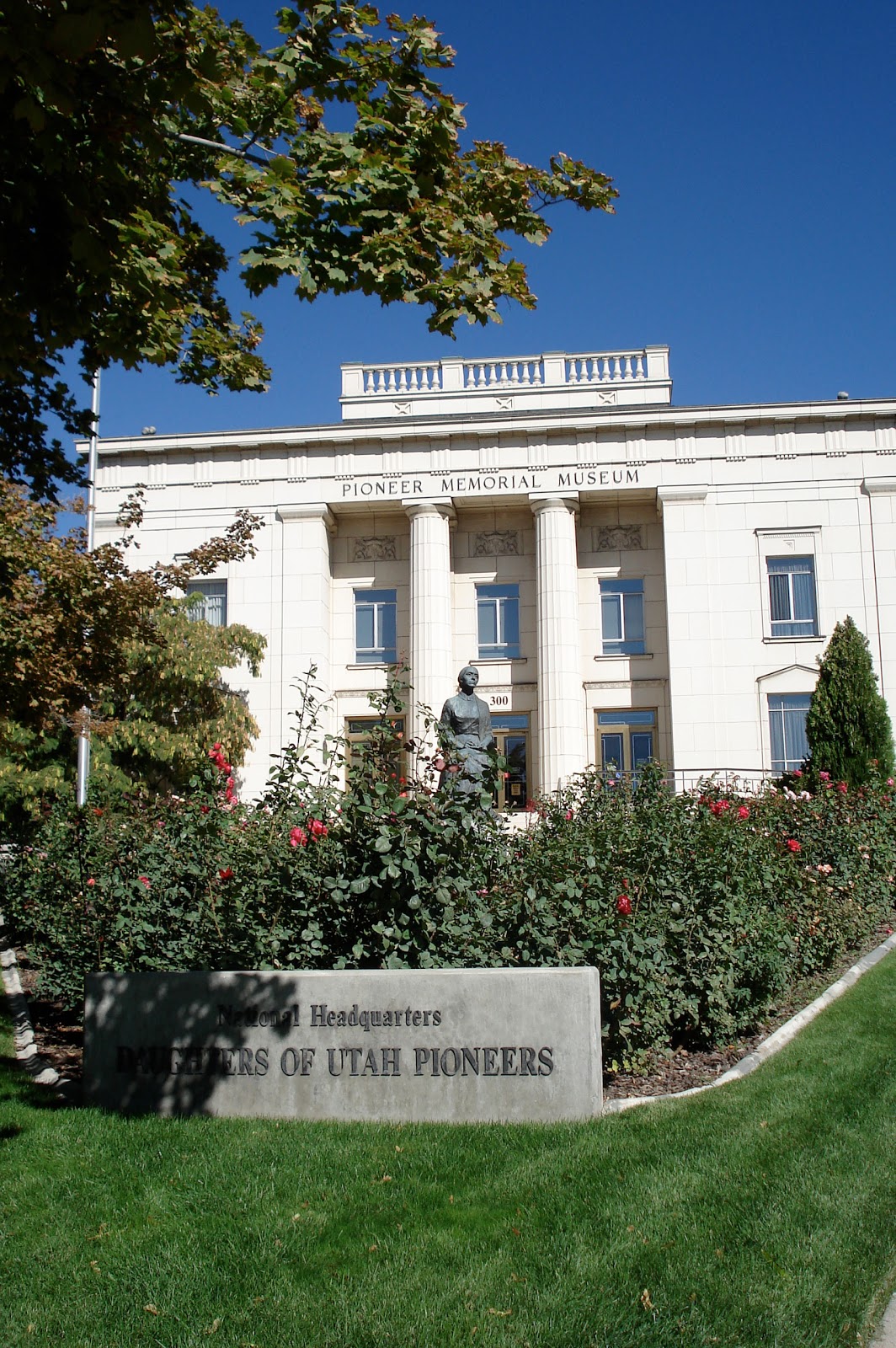
Seen at the DUP Museum


The Daughters of Utah Pioneers has a rather amazing museum, stuffed with pioneer artifacts and pictures and histories, next to the Utah State Capitol. During a visit yesterday, while in the basement display room, my eye fell on a green tin, about 6" wide by 6" high (plus a handle) by about 4" deep.

The typed display note said, "Tea canister bought in Farmington, Canada in 1840 by Isabella Hood. She died in Winter Quarters in 1847. Donor Edwin Pettit."


The tin is a green color, much used, and what is of the most interest was a paper pasted to the front of the tin. It said, in beautiful lettering,
This tin Canister [sic] was Bought by my wife Isabella Hood in Farmington 27 Miles North of the [unreadable] in Toronto Canada Just before we were married [unreadable] February 27th 1840. She died in Winter Quarters 20. March 1847 A. N. Hill
What an interesting and unusual primary source!

Picture of the Daughters of Utah Pioneers Museum from www.flickr.com/photos/katieelaine/1785518052/.

Friday, June 24, 2011

Memories of Henry Green, Part 1 of 4


My Father Henry Green

By Jack Green 
February 14, 1977

His were the dreams of the self-made rich, the Hearsts, Sinclairs, Fremonts, and others who won riches from the West. He often said that, “New wealth comes from the ground,” and entered into mining and agricultural projects with vigor and determination. Most of this effort resulted in frustration and few funds.

But there was another side to this man, a side that was most practical and successful. This was the visionary. The man who could look at his church, in which to worship in the fullest he left his native England, and its precepts, and see that here his faith would truly be fulfilled. He married twice under its holy covenants and today his numerous descendants attest to the truth of this vision. His examples of hard work, thrift, thoughtfulness, and devotion have endeared him to me and all his children and their descendants.

I must tell one story. While Dad was a Master Plumber, the Master Plumbers were all taken on a tour to Ironton, Utah, to visit the Pacific States Cast Iron Pipe Company foundry. This company had developed a new pre-inserted lead joint for its pipe that required only caulking on the job. It was to publicize this product that an excursion train ride, lunch, and plant tour, all free, was provided. I was dad’s companion on this trip. The only child, and I was only ten years old! We marveled in unison at the ice-coated willows sparkling in the sunshine and made even more dazzling by the speeding electric train, at the foundry processes, and the hard-working men stripped to the waist in the drafty building, hot as molten iron and cold as ice. It was my Dad, out of perhaps one hundred, who had his son beside him! Yes, I’m proud of him, proud to be one of his sons, and so strive to follow his lead in the visionary life.

Thursday, June 23, 2011

Henry Green: 1929 to 1941, Part 2 of 2


For the Christmas of 1935 the family was altogether for dinner at their home. When Howard had asked for Leone’s hand in marriage, Harry had said, “Yes, if you’ll always bring her home for Christmas.” He must have told others that, for whenever possible, the family was together for Christmas. He was a great family man and showed each member much interest and love. At these family gatherings, Christmases and birthdays, there would always be a program. Harry could still remember a humorous reading that he always gave. He kept the family laughing as he told of the patent medicine salesman selling his elixir. May had taken elocution lessons and had a great talent for dramatic reading (she often gave readings for programs and also taught it). She later acted in many plays as a member of the Salt Lake Theater group. They had a nice, cherry wood player piano that the grandchildren would perform on; the little ones loved the winding piano stool.

The grandchildren all remember their grandpa giving them dimes and quarters, just as he used to give his own children, more than they asked. He was such a generous person! Leone tells as he boarded a bus, he would pay the fare for those waiting with him. He was always helping someone—friends and relatives. When anyone needed help—his brothers and sisters, even strangers—he opened his home and heart to them. In later years, he took his sister Lizzie, alone and her memory gone, to live with them. Earlier, when she lived across the street (on “F” Street), he set [her] up in business selling food products. It wasn’t successful and for years Eliza was selling the remains, mainly vanilla.

Harry and Eliza had a strong testimony of tithing. Even when they had so little during their later years, they paid tithing on gifts and money received to help them out. Tithing was always the first consideration.

In the summer of 1936, Harry took a trip to California, staying first in Bishop Creek with Jack and then for two weeks with Harry and Lucy. The next summer (June 1937) Howard and Leone took their parents to Yellowstone for four days. This was probably their first trip there.

They were yet to move another time. Howard built a nice white frame home for them on the north-east corner of 6th Avenue and “G” Street. That summer, Harry, true-to-form, was working hard to help, moving large rocks as they were excavating. Apparently, this strained him physically. They moved November 1, 1940. Just barely settled in their new home, another tragedy hit. On December 10, Mildred’s husband, Ray, shot himself. She brought her family back to Salt Lake in January to start life over. Mildred said, “Father never got over it. He kept it on his mind, he felt so bad.”


In January of 1941, he contracted the flu and then pneumonia. He was taken to the hospital. Jack came home as it was very serious (he had taken a job with American Smelting and Refining Co.). In February they brought Harry back home. He wasted away and got so weak and thin that he could hardly be recognized. At 9:15 a.m., on Saturday, May 10, 1941, he passed away. A beautiful funeral service was held for him in the 20th Ward. Leone wrote, “Father’s services today were very impressive. He had many friends. We loved him so much, we hate to give him up.” All who knew him loved him—he was truly a great man.


Eliza lived eight years longer in this home with May. A year after his father died, Jack married Barbara Biesinger (on April 7, 1942) and lived in Salt Lake. Eliza enjoyed her children, grandchildren, and great-grandchildren coming to see her often. They have many fond memories of her. She passed away on the 24th of July, 1949, and all who knew her missed this wonderful woman. May married Clifton Davis the following year, February 1, 1950, and they carried on the family tradition of getting together on Christmas and going on summer outings. The great-grandchildren remember Santa’s visits and wonderful Christmas dinners especially for them. Summer camping, river trips, parties and canyon picnics have made enjoyable times with the families all together. One year the whole big (43) family rented a bus to Southern California where they “took over” a motel on the beach and had a wonderful vacation together.

This great family love and unity, instilled in us by Harry Green, has carried on through each generation. The posterity of Henry Green—ten children, eleven grandchildren, and many great- and great-great-grandchildren—is something he can be proud of.

Wednesday, June 22, 2011

Henry Green: 1929 to 1941, Part 1 of 2


The year 1929 brought with it the Great Crash. The Greens had to sell their home on “F” Street and move to an apartment on “I” Street, on the top floor. They moved the piano up on the outside. Times were difficult. May had to go to work (housework and cooking) to earn money to help support the family and to pay for her tuition at the University of Utah. It was ironical that Harry couldn’t help his own children with tuition when he had helped his nieces and nephews through the “U.”

He made some investments in mines in Idaho. In 1932, he, Walter Spencer, Jack, and his son-in-law, Howard (who also had lost everything in the Depression), worked a mine at Bennett (near Mt. Home), Idaho. Unfortunately, it wasn’t successful.

Harry went on a sales trip to New York in April 1931, to raise money for his mining ventures, especially the “Daley” mine at Bennett. Other of his ventures included the Manning Dump and Peruvian in Little Cottonwood Canyon. In a letter to his grandchildren, written en route to New York, he contrasted the conveniences of the beautiful Pullman train to the freight-train-like vehicle he had come on as a boy, “When you live as long as I, the trains won’t have wheels and travel on iron rails. You will be on a beautiful airship and instead of taking 40 or 50 hours to make this trip, you will make it in five hours.”

In a letter to Leone, he tells of going to a play with Mel Freebairn and his wife and seeing “the skyscrapers, this forest of beautiful buildings, thousands of cars and people on Riverside Drive.”

In a letter to his grandson Jay, he tells of tunnels under the river, the bridge across the Hudson River being built and escalators or “Moving Stairs.” He tells him to “read this in 1981.” He evidently was selling, as he said, “I have had a big-sized job getting the other fellow to see my view point. How well I shall succeed remains to be seen.”

He remained optimistic, writing, “I feel the Faith and Prayers of the good people that are ascending to the great Master of all in my behalf, I cannot see anything but good coming to me. And I am reconciled no matter what it is that it will all be for the best.” In spite of setbacks and disappointments, he remained cheerful. He was always concerned about his family. In the same letter he said, “I, too, pray for you and when I think how wonderful you boys and girls are progressing, not only in the perishable things, but those that are enduring throughout all time and the Eternities. Praying for your happiness and the health and continued blessings of the association of husband and children. Affectionately, Dad.”


A move from “I” Street to 4th Avenue and “E” Street came in June, 1934, and seemed to give them a “lift on life.” They were moving back to 20th Ward and old friends. A few quotes from a letter he wrote: “When I returned from work about 5:00 to my surprise, all that remained in the apartment was the piano.” His daughters and sons-in-law had moved for him. “Mother seems like another person, back to the old days. Talk about a change, well you will know more from mother when the rush is over.…I have just 27¢ left out of $25.00 after taking care of telephone $5.00, light $5.00, gas $2.87, moving piano $5.00. Although we have but the 27¢ for ‘grub’ we feel a lot more like taking on new life.”

Harry was more-or-less retired now at sixty-seven. This gave Eliza and him a lot of time to spend with their children and grandchildren. They loved to have them visit. They also spent many hours serving in the temple. They were devoted grandparents to their 11 grandchildren. Harry had always shown an interest in them, writing letters to them, and talking specially to them in letters. The grandchildren loved to come and stay all night. Eliza was a fantastic storyteller, telling many stories of pioneers and Indians. She would also tell their fortunes. Harry took them on excursions to the museum on Temple Square, to the capitol building, and to Memory Grove. One time he took Gwen, Marjorie Ann, and Bob to the top of Ensign Peak and told them to remember this hike, when their Grandpa Green was 72.

He was always proud of his family and their accomplishments. His son Harry was a prominent businessman, a sales representative for U.S. Rubber. He, Lucy, and his daughter, Marilyn (another daughter, Marjory, died at birth), lived in San Mateo, California, and later in New York. Bert (or Chuck, as they called him) had gone into mining. He and Glay lived in Bishop, California, until they moved to Bolivia in 1939. Jack and May attended the University of Utah. Jack graduated in Mining Engineering and May in Elementary Education. She taught first grade at Washington School. Mildred and Ray and their children (three of them) moved to San Jose, California.

Tuesday, June 21, 2011

Henry Green: 1921 to 1929


In 1921, Harry decided to surprise his family (he was often impulsive and made decisions quickly). He thought it would be nice to be on the Avenues and had the money to buy a house, so he bought a beautiful home there at 127 “F” Street. When Lucille came back from a vacation at Bear Lake, the family had moved to the new home! It was a large and comfortable home, with a big carriage house in back. By now, they had an automobile. Lucille and Mildred remember the flashy “Stutz” (racing) sports car with red seats, and later a new Ford touring sedan with window flaps which they drove on a trip to southern Utah. When Mildred was learning how to drive, she knew how to start the car, but not how to stop it, and consequently ran through the garage. Harry hardly ever lost his temper, but he did this time, and it was bad! He was usually very pleasant and mild-mannered, and had a typical English sense of humor, except when teased about his accent. His children loved him and wanted to please him. He only had to say, “I would like you to do so and so,” and they would do it.

The younger children went to Lowell School. May started there. Mildred, fifteen, had her choice of attending East or West High Schools. She started at West, but under pressure from Lucile and young Harry, she switched to the new East High School. Once Harry, Lucile and Mildred thought it would be good to have an apartment. When they told their dad, he broke down and sobbed, so they changed their minds and stayed at home.

Harry met Lucy Coleman Hart, whom he fell in love with; they were married July 19, 1922. Lucile had some good jobs as secretary. On a trip to Yellowstone, she met William Lester Glade, through her aunt May Green. They were married in the Salt Lake Temple on June 6, 1923, and had a reception at the home on “F” Street.

The married children and grandchildren often came to the home on “F” Street, always gathering for Easter, Thanksgiving, and Christmas. There are many happy memories: delicious turkey dinners in the large dining room, after-dinner games of Pit, Touring, and Knucks-Up around the table, huge Christmas trees with a village around the bottom which got more elaborate each year. The grandchildren loved to watch Jack building his boat for Great Salt Lake.

Harry did very well with his business. He was elected president of the National Association of Master Plumbers, and traveled to New York and elsewhere for conventions. Once he went to a convention in Galveston, Texas, and brought back a book on the famous flood of 1900.

Active in the 20th Ward, he was counselor in the High Priests Quorum. Eliza worked in the Relief Society and sang in the Singing Mothers. They had many friends and were very happy there.

In 1926, Harry bought a large ranch at Widstoe, Utah, not far from Bryce Canyon, in partnership with a Mr. Kimball. They schemed to make a fortune growing lettuce, planning on the railroad going through there. He worked hard for weeks at a time at it. He wrote, “I am working harder and putting in longer hours than I have done in my life before.” In spite of his great efforts, the ranch was not successful.

On May 19, 1927, Mildred married Ray Noble. They went to get their marriage license on their lunch break and, on the spur of the moment, decided to get married then, too. When she finally told her parents, they were so shocked that they started to cry. Harry made the most of it, though, and invited the family for ice cream to celebrate.

While in high school, Bert married beautiful, auburn-haired Glacia (Glay) Squires. She was a talented pianist. They lived at home for a while.


Photo of the 1914 Stutz Bearcat from Wikipedia.

Monday, June 20, 2011

Henry Green: 1906 to 1921, Part 2 of 2

The Greens camping in Big Cottonwood Canyon, date unknown.

Another son, Jack Heber, was born to Harry and Eliza on October 14, 1912. When Jack was about two years old, he had a very serious accident—he pulled a pot of scalding cabbage over on him which burned him terribly. His skin came off with his clothes. To make things worse, the power was off at the time due to an electrical storm. For weeks he was bandaged like a mummy. Lucile and Leone stayed up at nights wheeling him in a wagon to comfort him.

The family had its share of serious illnesses. When Bert was a baby he had pneumonia and almost died. Lucile had typhoid fever, Mildred had diphtheria, and Jack had scarlet fever.

Another daughter, May, was born October 5, 1914. Two and one-half years later, a baby was stillborn (February 2, 1917). About this time, twelve-year-old Mildred was given the ultimatum that she couldn’t keep packing her trunk and going from one home to another. Papa said, “This is it, no more!” Aunt May and Aunt Lily had both wanted to adopt her. Mildred, in living with the Pettits, had a big family to spoil her. Will had a grocery store; he brought her candy and rocked her until she was five. Lily, a dressmaker, saw that she was dressed beautifully; she had hairdos and new shoes often and plenty of spending money. Everyone made a big fuss over her, but she had no one person to tie to. When she came home and had to work and baby-sit, she resented it. Especially as a teenager, when her friends were having a good time, she had to stay home and tend May while the family went to church. She said this helped make her feel resentful toward the Church. Leone, at 20, was working as a bookkeeper and would escape housework by going to shows. Lucile ended up being the one to help at home.

Henry Green prospecting.

Around 1916 or 1917, Harry went prospecting for gold in Arizona. He worked in the Joy mine near Kingman, in northwestern Arizona. To extract the gold ore from the slurry mixture, Harry used a centrifugal machine shaped like a pot-bellied stove. After his prospecting was over, his kids delighted to watch the extracting machine whir around as it sat in the barn on 2nd West. Harry had many adventures while mining in Arizona. Once he got stuck in some quicksand while getting logs. On his way home to Salt Lake, he brought back petrified wood from the Petrified Forest in north-central Arizona.

Harry kept very busy with his plumbing business, trying to support his large family. Leone remembers that the family ate alone many times in the evening while he was at work. He was also active in church work. At first he was president of the branch of the 4th Ward that met in a small building on the north side of 13th South, east of 2nd West. Later the 30th Ward building, made of white glazed brick, was built on Goltz Avenue. Here he was called as superintendent of the Sunday School; when released, he was presented with a leather rocking chair. Later, in August 1919, he became counselor to Bishop Charles Cottrell.

His daughter, Leone, married Howard J. Layton when he came home from his mission in England. They had dated before and corresponded during his mission. Lucille remembers peeking over the transom in the library to see if he kissed her while he was courting her. On October 17, 1917, they were married in the Salt Lake Temple. A reception followed at the home, which was decorated with ferns and autumn leaves. Howard and Leone built a small home on 121 Goltz Avenue in the same ward as her parents.

Harry’s son, Harry, and his son-in-law, Howard, were both in the army during World War I. Harry had been attending Utah State University where he was a big football star. He continued playing while a lieutenant in the cavalry.

Harry’s children looked to him for help and counsel. Howard wrote while in the service, “Somehow your letters seem to give a fellow something to think about and a sort of a stimulant to keep his head up and his proverbial ‘upper lip’ stiff. I am glad to think that now I have a couple of ‘dads’ to look up to and to get advice from.”

Howard asked him to use his influence to get him released two weeks before discharge to be home for the birth of his first child. He did so, and Harry’s first grandchild, Jean, was born January 19, 1919, to Leone and Howard. Harry gave her a name and a blessing. A big fuss was made over her. Mildred and Lucille used to fight to see who would get to take care of her. Being the first grandchild on both sides of the family, she received lots of attention.

To be continued...