Monday, December 20, 2010

Merry Christmas!

In the midst of all the bustle and hurry of the Christmas season, it is good to pause for a moment and remember what Christmas can mean for a child: the magic, the anticipation, the sense of wonder, the beloved faces of family and friends, and that special gift under the Christmas tree. Here are a few pictures from Christmases past.


Merry Christmas!

Wednesday, December 15, 2010

Elizabeth Hayward Causes: The 1900 Utah Elections, Part 2

A reader asked about the purpose of the different conventions represented by the ribbons in the last post. Here are articles about each of the four conventions.

February 24, 1900—Democratic County Convention—Deseret Evening News, page 1


"When Chairman Lloyd announced announced [sic] that the convention was in order the seats allotted to the delegates were well filled and a number of lady representatives graced the assemblage."

March 1, 1900—Democratic State Convention—Deseret Evening News, page 1-2


September 6, 1900—Democratic State Convention—Deseret Evening News, page 1


September 14, 1900—Democratic County Convention—Deseret Evening News, page 1


In this last article, Henry Hayward is listed as one of the officers of the Salt Lake Third Municipal Ward. I have just been assuming that the ribbons were Elizabeth's. Is it possible that Henry was the only delegate from the family? Or were both he and his wife Elizabeth delegates? I have no idea where I would find a list of the delegates to the four Utah Democratic Conventions in 1900. There were 540 delegates to the last convention.

September 15, 1900—Democratic County Convention—Deseret Evening News, page 1

Tuesday, December 14, 2010

Elizabeth Hayward Causes: The 1900 Utah Elections

My time line of the life of Elizabeth Hayward, which I will post at some future date, notes that she was elected to the city council in 1895 for one term. I'm not sure what a term was in Salt Lake City at that time. One year? Two years? Four years? That was the year that her youngest child, John Ewing, was born, so it would have been a very busy year for her.

Five years later, she was heavily involved in the Utah elections. Here are some of the ribbons from the different conventions that year. They are largely self-explanatory.

Delegate—Democratic County Convention.—Feb. 24, 1900

Delegate—Democratic State Convention.—March 1, 1900

Alternate—Democratic State Convention.—September 6, 1900

Delegate—Democratic County Convention—Sept. 14-15, 1900

So 1900 would have been another busy year with four children at home: Jean, who was 13 that year, Leah Merle, who would turn 11 that year and would live for another five years before dying in 1905, Bess, who was eight that year, and John, who was five.

Monday, December 6, 2010

Elizabeth Hayward Causes: Uncle Jesse for Governor

Uncle Jesse for Governor

Who was "Uncle Jesse"? I can't remember a governor of Utah named Jesse off the top of my head. Did he run and lose the election?

It looks like it is time to turn to Google.

Okay. The governors during the time that Elizabeth Hayward was involved in politics were:

Heber Manning Wells (1896-1905), John Cutler (1905-1909), and William Spry (1909-1917), all Republicans. [William Spry was a close associate of John Morgan in the Southern States Mission and throughout his life, so he has been mentioned on this blog a number of times.]

Simon Bamberger (1917-1921), Democratic.

Charles R. Mabey (1921-1925), Republican.

George Dern (1925-1933), Democratic.

And that's probably late enough. More on Bamberger, Mabey and Dern in future posts.

So, Uncle Jesse was not a governor. Who was he?

The first Google search points to a character on Dukes of Hazzard. Nope. Too late, and Elizabeth Hayward didn't seem to treat her political involvement with humor. (As far as I can tell.)

Adding "Utah" to the search string reveals the obvious answer: Uncle Jesse was Jesse Knight. He was a son of Newell Knight, a well-known character in Mormon history. 

Jesse Knight was one of the few Mormons involved in mining, and he was hugely wealthy, and amazingly philanthropic. He was well beloved in Utah and helped to save the Church of Jesus Christ of Latter-day Saints from financial difficulties in the late 19th century. The Utah History Encyclopedia notes that:
Essentially more sensitive and modest than most business leaders during this age of ruthless capitalism and conspicuous consumption, he probably deserved the endearing nickname of "Uncle Jesse"—a rich but giving uncle. In fact, he believed that his money was for the purpose of doing good and building up his church; he regarded the matter as a "trusted stewardship." As he once said, "The earth is the Lord's bank, and no man has a right to take money out of that bank and use it extravagantly upon himself."

The article also notes that he never sought high political office. So why was he running for governor?

The answer: he wasn't. According to an article by Diane Mangum, "Jesse Knight and the Riches of Life," which is well worth reading:
Jesse was not only at the economic hub of the community but active in civic affairs as well. He was a lifelong Democrat, and in 1908 his party asked him to run for governor. Jesse declined. He felt that he was too uneducated for the job. [Gary Fuller Reese, “Uncle Jesse: The Story of Jesse Knight, Miner, Industrialist, Philanthropist,” master’s thesis, Brigham Young University, Provo, Utah, June 1961, p. 85.]

Gary Fuller Reese's thesis is available online (see link above, and if you want to read the entire thesis, scroll down on the left, and download the printing version).

Here is what the New York Times said about the event:
REFUSES TO RUN IN UTAH
———
Jesse Knight, Named by Democrats for Governor, Won't Accept.

LOGAN, Utah, Sept. 23.—The Democratic State Convention which adjourned late last night did not adopt the plank favoring the absolute separation of Church and State, as was first reported.

Jesse Knight, who was nominated by acclamation for Governor, said to-day that he would refuse to accept the nomination, as his age and varied business interests made it impossible for him to give the proper attention to the duties of the office should he be elected. [September 24, 1908, New York Times.]
Whatever the reason he refused to run, after he declined the nomination, his son J. William Knight ran in his place but lost the election.

One of Knight's business partners, George Dern, served as governor of Utah several years later, and Jesse's grandson Goodwin Jess Knight served as governor of California from 1953-1959.

Friday, December 3, 2010

Elizabeth Hayward Causes: Some Random Ribbons

These ribbons are rather representative of Elizabeth Hayward's involvement in different causes: her political party, the Daughters of Utah Pioneers, a committee ribbon, and "Hospitality," probably a ribbon from serving on that committee for some event, and two Utah ribbons, one with her name on it. The Utah ribbons are probably from her service as a delegate at Democratic National Conventions.


Thanks once more to Toni for all these images!

Wednesday, November 24, 2010

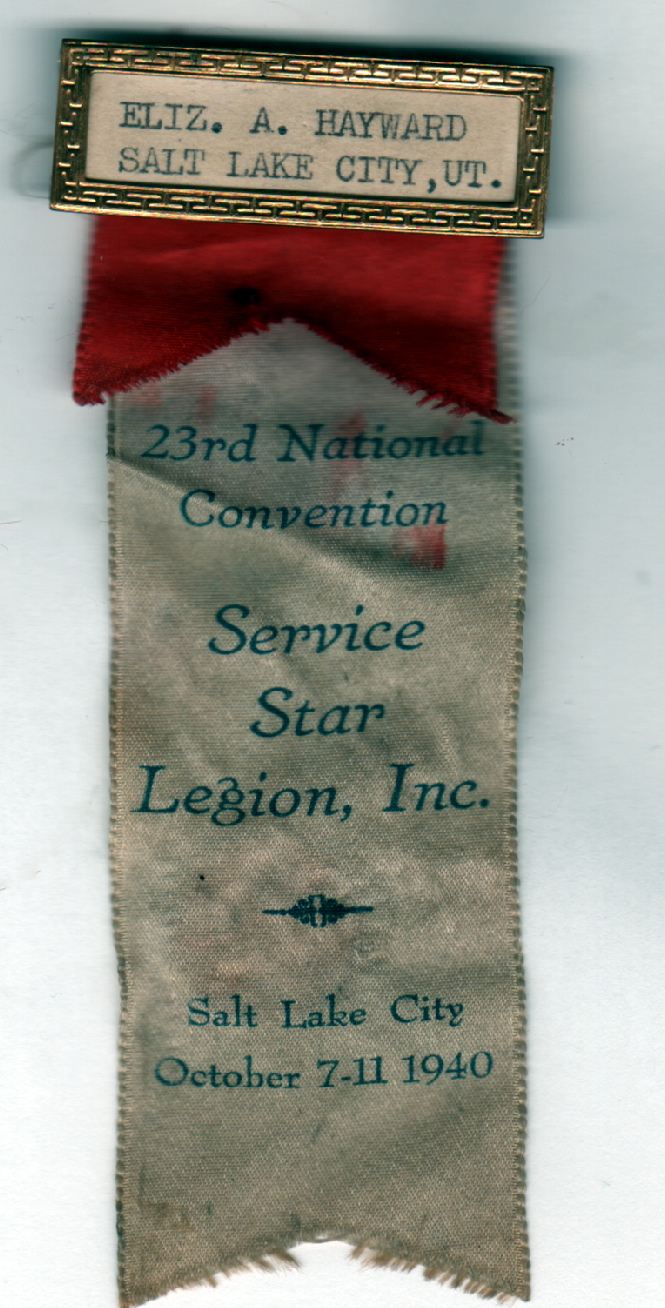
Elizabeth Hayward Causes: Service Star Legion

After World War I drew to a close, a group of women in Baltimore formed an organization called the Service Star Legion. The organization was founded in 1919 to assist servicemen and their families, support the United States government, and lend their efforts to related projects such as veteran's hospitals.

In Salt Lake City, a group called the War Mothers, organized in 1918, merged with the Service Star Legion in 1920. Elizabeth Hayward's son John Ewing Hayward had served in the war, and she joined the Service Star Legion. She served as corresponding secretary, chaplain, and parliamentarian for the Chapter.

The Salt Lake Chapter created Memory Grove Park in Salt Lake City in the 1920s. I cannot find the entry in the Marriott Library catalog at the University of Utah, but I see this description of a collection in the library on a genealogy site in Pennsylvania (Tri-Counties Genealogy):
Service Star Legion, Salt Lake County Chapter Papers (Ms 222)

University of Utah Marriott Library, Manuscripts Division

The Service Star Legion, Salt Lake County Chapter Papers (1923-1975) holds material regarding the Salt Lake County Chapter, the Utah Division, and the national organization. Included are annual rosters for the Salt Lake County Chapter, a 1951 handbook, and three convention programs from the 1940s. Also present are histories of projects and programs. Papers from the Utah Division include a constitution, by-laws, articles of incorporation, and convention programs and minutes. There are also two programs from the Utah-Wyoming Division from the early 1930s. A constitution and convention programs for the national organization are included, as are brief histories of the organization, copies of the national magazine, The Service Star, and an autobiography by Cora Baker, a national charter member. News clippings from 1923 to 1968 provide information about the activities and people associated with the Service Star Legion. Two scrapbooks also hold news clippings, as well as photographs, reports and other items. The Service Star Legion was organized in Baltimore, Maryland in 1919. In Utah, the original group was known as the War Mothers (organized 1918) that affiliated with the Service Star Legion in 1920. The group's purpose was to bring comfort and aid to servicemen and their families, and to support the U.S. government. They pursued civic projects, such as assistance with veterans hospitals. The Salt Lake County Chapter, beginning in 1926, improved and supported Memory Grove Park. The organization planted trees honoring Utah's war dead and Memorial House is dedicated to their memory. A register is available. 
The Service Star Legion does not seem to exist any more, but two similar organizations exist today, Blue Star Mothers for mothers with a child in the armed services, and American Gold Star Mothers, for mothers with a son or daughter who died in the service.

Memory Grove Park, to the east of the Utah State Capitol Building


Photo of the ribbon from Wessman cousin Toni. Photos of Memory Grove Park from http://www.flickr.com/photos/tyreseus/146710249/ and http://www.flickr.com/photos/tyreseus/146715231/.

Tuesday, November 23, 2010

Elizabeth Hayward Causes: Ten Percent, Part 2

After searching in Google Books on the term "American history 'ten percent' progressive" and considering Elizabeth Hayward's Progressive ideals, and specifically her interest in protecting the rights of children as well as her strong support of President Woodrow Wilson, the most likely answer to my question about what her "10%" button meant is the following.

In 1919 President Woodrow Wilson signed the Child Labor Tax Law.
The Child Labor Tax Law is title No. XII of an act entitled 'An act to provide revenue and for other purposes,' approved February 24, 1919.... The heading of the title is 'Tax on Employment of Child Labor.' It begins with section 1200 and includes eight sections. Section 1200 is as follows:
    'Sec. 1200. That every person (other than a bona fide boys' or girls' canning club recognized by the agricultural department of a state and of the United States) operating (a) any mine or quarry situated in the United States in which children under the age of sixteen years have been employed or permitted to work during any portion of the taxable year; or (b) any mill, cannery, workshop, factory, or manufacturing establishment situated in the United States in which children under the age of fourteen years have been employed or permitted to work, or children between the ages of fourteen and sixteen have been employed or permitted to work more than eight hours in any day or more than six days in any week, or after the hour of seven o'clock post meridian, or before the hour of six o'clock ante meridian, during any portion of the taxable year, shall pay for each taxable year, in addition to all other taxes imposed by law, an excise tax equivalent to 10 per centum of the entire net profits received or accrued for such year from the sale or disposition of the product of such mine, quarry, mill, cannery, workship, factory, or manufacturing establishment.' (Bailey v. Drexel Furniture Co., 259 U.S. 20 (1922))
Basically, this act was an attempt to regulate and discourage child labor by instituting a ten percent tax on the net profits of business that employed children younger than fourteen or had them working more than eight hours a day, six days a week.


This tax was found unconstitutional in 1922 by the U.S. Supreme Court in the act quoted above, Bailey v. Drexel Furniture Company.


The photo is from Wikipedia and was taken by Lewis W. Hine in 1910. The subject is "Rose Biodo, 1216 Annan St., Philadelphia. 10 years old. Working 3 summers. Minds baby and carries berries, two pecks at a time. Whites Bog, Brown Mills, N.J. This is the fourth week of school and the people here expect to remain two weeks more. Witness E. F. Brown. Location: Browns Mills, New Jersey."

Elizabeth Hayward Causes: Ten Percent


This will be a short post, since I can't figure out what this means! Anyone know?

Monday, November 22, 2010

Elizabeth Hayward Causes: March of Dimes

The virus poliomyelitis, also known as polio or infantile paralysis, is highly contagious and can easily be spread from person to person. If the virus enters the bloodstream it can result in severe damage to the central nervous system and muscle weakness or paralysis. It usually affects children.

A series of widespread polio epidemics began in the early 20th century, resulting in great suffering throughout the United States. President Franklin Delano Roosevelt caught polio at the age of 39 and was severely crippled the rest of his life. In 1938, President Roosevelt established the National Foundation for Infantile Paralysis to defeat the polio epidemic. The history of that organization is one of the great medical stories of the 20th century.

The foundation began its effort with a radio campaign asking everyone in the country to contribute a dime to fight polio. The foundation's fundraisers were called The March of Dimes, and that name stuck to the entire organization. The March of Dimes funded the work of researchers Jonas Salk and Albert Sabin and many others in the development of the two successful polio vaccines.

Franklin Delano Roosevelt was remembered after his death in 1945 for his part in the eradication of polio by having his picture placed on the dime.


Along with many of her other efforts to benefit the healthy growth and development of children, Elizabeth Hayward was involved in the March of Dimes. This little button is one of the items from the collection of her political and social memorabilia.

Elizabeth's grandchildren grew up with  children who had suffered from polio. Her grandson John injured an ankle during a game of tag and remembered the following story:
One of my friends, Don Weaver, had suffered from polio and was completely incapacitated from the waist on down; he loaned me a pair of crutches that he had, so I could walk around with him—he on his leg braces and on his other crutches. This was during the summer when we liked to go swimming in one of the large irrigation ponds in the Burch Creek [Ogden] area. One day after I had shown some improvement from my ankle injury, we went to a pond with one of his brothers and with a couple of my brothers. I almost didn’t get there, because traveling for about a mile or a mile and one-half on crutches was a real chore—especially for me on crutches, but not for Don because he had been doing it for years and had tremendously strong arms and shoulders. Coming back after swimming in the cold irrigation pond was downhill and easier than going up...


Despite the race for a cure, one of Elizabeth's great-grandchildren caught polio in September 1954, just seven months before Dr. Jonas Salk announced that the polio vaccine was "safe, potent, and active." While the great-grandchild suffered a comparatively mild case, he still feels the effects of the disease many years later.

Although there is still no way to cure polio, the disease has been almost entirely eradicated throughout the world, and will continue to be more and more of a distant memory as long as vaccination efforts continue, thanks to the dimes and community efforts of many people like Elizabeth Hayward.


These images in this series were provided by Wessman cousin Toni. Thanks, Toni! The picture of FDR and the March of Dimes poster are from their respective Wikipedia entries. The newspaper clipping is from the Kane County Standard (September 16, 1949) and illustrates some of the changes in medical care during this period.

Thursday, November 18, 2010

Henry Overson's Missionary Journal: Other Contents

Besides yesterday's letter from Eva Overson (Tanner) to her father Henry Overson, the journal  contained a one peso note from 1967, twenty years after Henry died. Here it is, front and back:


And the back inside cover of the journal had some notes about the nine Overson children and a very short index to the contents of the journal:


Eva Margaret [Overson Tanner]     Died leaving 2 boys.
Henry Victor
Albert Nephi     Died a baby. [Three years old.]
Edgar Pratt
Henry [Harry] James
Evan Joseph
Ivan George     Died age 22.
Ross Wallace
Marion Peter

London     [page] 1
Luton        [page] 9