Sunday, December 20, 2020

Marinus Christensen's Birth Family

Marinus Christensen was adopted as a small child in Denmark by Jens Christensen and Karen Marie Johannesen. Not long afterward they went to America. Jens died as they crossed the Great Plains so Marinus grew up in the home of his sister and brother-in-law Mary and Ove Oveson. When he died, his son could not give the name of Marinus's parents for the death certificate.

Now, we have easy access to Danish records. The records show the birth of a child named Marinus Marcusen, just a few days after the family remembered, but in the correct rural community.

The official recorded as parents, "The unmarried Kirsten Marie Johansen, 21 years, from Kjæret, and the assumed father, bachelor Anton Marcusen from Smedegaard." Anton Marcusen appears to be Anton Marqvordsen. It's not the same surname, but he appears to be the only Anton from their rural area. In the 1860s Anton appears to have had two illegitimate sons with Kirsten (Christian and Marinus), one illegitimate daughter with Ane Kathrine Jensdatter (Petrine Marie), and then a legal family in the 1870s with Hanne Laurine Christensen.

There is still some conjecture involved in these conclusions, but here's an additional bit of evidence. Marinus was adopted by a family and taken to the US. He eventually lived most of his life in Arizona. His probable half-sister and her husband and children moved to the US in 1898 and settled in North Dakota. Her descendants who have done DNA testing show up as relatives. Here is a picture shared by her family. Note her resemblance to Marinus!

Identified as "Back row George Jensen, John, Ed, Arthur, Henry. Front row Chris, father Chris Jensen, Dagmar, Maida (mother), Alma." From Ancestry, courtesy of jazzslider, Jens and Helen Christensen, and Steve Page. 

Here are a couple of pictures of Marinus to compare.


And the probable half-brother and half-sister a little larger. They have a lot of shared facial features!


Monday, May 11, 2020

When FamilySearch Makes Changes

John Morgan's FamilySearch Family Tree entry is blocked from changes because he was a Latter-day Saint general authority. FamilySearch blocks changes to certain notable people whose entries tend to become the target of either malicious changes or adoring but not genealogically significant content.

In order to make changes to a closed entry, you have to contact FamilySearch, and I've never bothered sending in information on John Morgan. Someone did recently, so he is better sourced than he was before.

However, FamilySearch just made an unfortunate change at someone's request. John Morgan had one legal wife, Helen Melvina Groesbeck, two plural wives, Annie Smith and Mary Ann Linton, and at least two women sealed to him after their deaths including Mary Elizabeth Kilgore.

The given explanation when someone removed Mary Elizabeth Kilgore from the family is "Incorrect relationship. Not married in life."


Severing the relationship without understanding the history and adding an explanation of the temple work done by the Morgan and Kilgore families to preserve the family connection certainly is not malicious, but it is ignorant in a way that ends up being malicious.

It's truly unfortunate that the change was requested without also adding something to document this familial link, and it is doubly unfortunate that FamilySearch agreed to the change and made it without also documenting what happened.

Ignorance all around.

If you see these kind of Latter-day Saint connections where families had someone sealed into their families — their form of adoption — please preserve the relationships, either in the Family Tree or in the Memories sections for the people involved. Please do not vandalize entries without understanding what was happening.

Here is what you would read to understand the nineteenth century practice of Latter-day Saint adoptive sealings.
Stapley, Jonathan A., "Adoptive Sealing Ritual in Mormonism" (Summer 2011). Journal of Mormon History. Available at SSRN: https://ssrn.com/abstract=1885588

Sunday, April 26, 2020

John Tanner's Mission: Sources


In the ongoing effort to move the content from this blog over to FamilySearch Family Tree, I compiled the information here and added some new information to a document called John Tanner's Mission: Sources. You can view and download it here:

Thursday, December 26, 2019

John Tanner Documents at The Joseph Smith Papers

The Joseph Smith Papers continues to identify and catalogue papers about the life of Joseph Smith. Their biographical entry for John Tanner has quite a few new entries. I've added links or images of the important items to John Tanner's FamilySearch page. Here's a promissory note that shows John Tanner's signature:


Here's a screen shot of the listed documents:


JS and 30 others, Promissory Note, Kirtland Township, Geauga Co., OH, to Holbrook & Ferme, [New York City, New York Co., NY], 1 Sept. 1837; handwriting of William Perkins; signatures of authors; two pages; Ohio Historical Society, Columbus, OH. The Joseph Smith Papers, https://www.josephsmithpapers.org/paper-summary/promissory-note-to-holbrook-ferme-1-september-1837-a/2.

Sunday, June 23, 2019

The Wessman Home in Göteborg

If you were to visit today, this is the Swedish neighborhood where the Wessman family lived in the 1880s through the 1890s. It appears to have been greatly gentrified.


The Swedish Household Examination Books are an excellent genealogical source. Here is the page for the Wessmans. Their entry begins on the top line.


Here is the first part of the entry for the family.


It lists each member of the family with names, exact birth and marriage dates, whether they'd been vaccinated for smallpox (everyone but the baby), and their religious status.

Amanda and Johan Wessman and baby.

Officials updated the entry yearly. This is the second page showing the name of the neighborhood on the top, Skolgatan 13 and Nygatan 23 (see that corner in the Google Streetview above).


It records their previous residence. If I'm reading it right, they moved within the city to their current location on November 5, 1884. The last columns show Johan moving to a different location and Amanda and the rest of the family moving to America.

"Sweden, Household Examination Books, 1880-1930," database with images, FamilySearch(https://familysearch.org/ark:/61903/1:1:QLP2-T36M : 5 April 2019), Johan Westman, from 1885 to 1895; from "Sweden Household Examination Books, 1860-1920," database and images, MyHeritage(https://www.myheritage.com : n.d.); citing from 1885 to 1895, 12842981, Haga AI 6, various Lutheran parishes, Sweden.

Sunday, May 12, 2019

A Matrilineal Chart for Mother's Day

Happy Mother's Day! For the occasion, here is a chart of matrilineal descent, with pictures where possible. I have joked before that my matrilineal line goes straight back to Scotland, and that's where I got all my qualities of frugality and thrift. (This post is originally from May 2011, here updated and republished.)

My mother with her mother, Beverly Lucille Glade Wessman (1924–2008). Grandmother Beverly was a friendly and hospitable woman and enjoyed spending time with her large extended family.

Beverly's mother was Lucy Lucile Green Glade (1898–1980). She lived in Salt Lake City her entire life and liked to travel during her long widowhood.

Lucile's mother was Mary Isabell Pettit Green (1866–1905). We have a copy of her charming diary from when she was dating her husband. She died from complications of childbirth, and left several young children.

Mary's mother was Rebecca Hood Hill Pettit (1845–1922). She liked to tell the story that when she was a teenager she was so sick that the doctor told her she would never have children. She had fourteen, plus her three step-children.


Rebecca's mother was Isabella Hood Hill (1821–1847). She was born and married in Canada, and died as a young mother and Mormon refugee at Winter Quarters, near today's Omaha, Nebraska.

Isabella's mother was Margaret Bisland Hood (1791–1856). Born in Glasgow, Scotland, she and her husband emigrated to Canada in 1820 with the Lanark Society Settlers.

Margaret's mother was Agnes Pollack Bisland or Bilsland (1762–1842) of Glasgow, Scotland. Agnes's mother may have been Jean Glass Pollack, and her mother may have been Marjorie Geddes Glass, but there does not appear to be any comprehensive and reliable research on these families.


The picture of Rebecca Hill Pettit is from FamilySearch, courtesy of Sharon Wilbur. The next picture is from a family collection and is said to be Isabella Hood Hill and is historically possible, but the exact source of the attribution and any knowledge of the existence of the original has been lost to time. The picture from the gate of the Winter Quarters Pioneer Cemetery where Isabella Hood Hill is buried is from Flickr, courtesy of Dan McLean. The picture of Margaret Hood's gravestone in Creemore Union Cemetery, Simcoe, Norfolk, Ontario, is from FindAGrave, courtesy of Jan Darby. The photo of the Glasgow Cathedral is from Pixabay. 

Thursday, April 11, 2019

"Twittertonians"

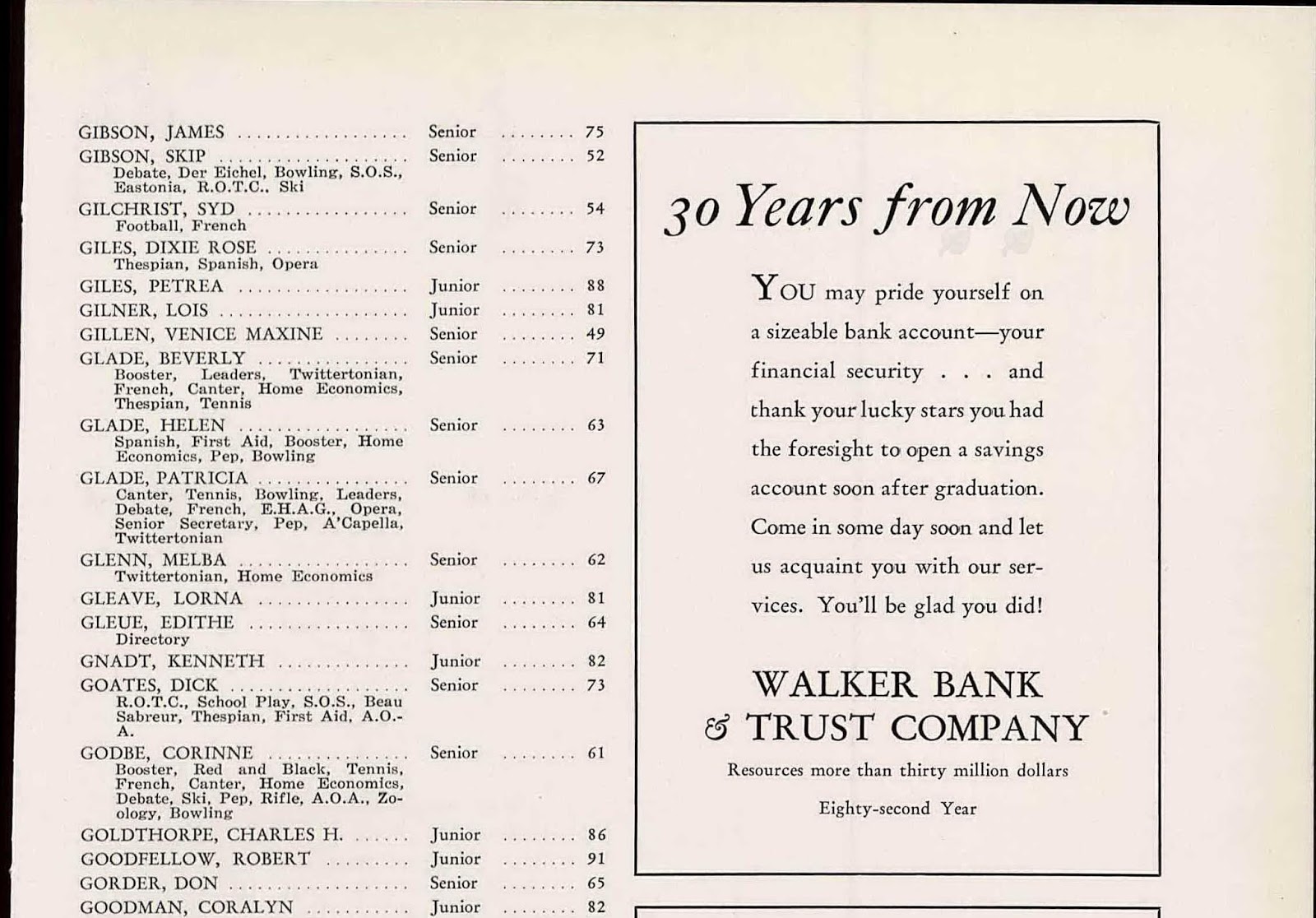
This came up through a hint on Ancestry. This is from the East High School yearbook from 1941 showing Beverly Glade (Wessman) and her cousin Patricia Glade (Curtis) participating in a number of school activities including "Twittertonian." Any suggestions what that was? Definitely not connected to today's Twitter!


Friday, November 16, 2018

Editor's Note: Comments!

Blogger hasn't been sending notifications for the better part of a year, and just the other day I noticed that there were about a dozen unapproved comments. Thank you to all who have left questions and comments. 

It is surprising to see that this blog is approaching half a million page views. I started it in September 2007 when my youngest was at home full-time with a serious medical condition and I needed a project. My first efforts mostly consisted of sharing short biographies written by deceased family members, plus a few of my own preliminary efforts. Some of my earlier forays into biography are cringe-worthy, but given some time, practice, education, expert mentorship, and an audience, I've learned valuable biographical-writing skills.

So, before unquestionably sharing them, how do you assess the reliability of a family history? It's fairly straightforward. 

First, ask a series of questions. Who wrote the biography or family history? What personal connection did the author have to the subject? Did the author know the subject of a biography personally? If so, what was the nature of the relationship? What resources did the author have available when he or she wrote the history? Are sources listed? Did the author silently edit family accounts?

Next, source check every detail that can be checked in the history. Are names, dates, places, and events reasonably correct? Are historical movements and themes correct? Does the author understand what was happening?

The project I'm currently finishing is on slavery in the American West and most family histories written by descendants of slaveowners compromise themselves through many woeful misunderstandings of the events and times. Many of the authors of these accounts made an attempt to reconstruct events and people about a century after the original events and I cannot recall that a single one said: Here's what we can remember, but it was all so long ago, so please forgive any errors that have crept into the narrative. That's a lesson to learn from the Book of Mormon, which specifically does that ... on the title page.

So, looking back at a decade of content (including a trailing off in the last few years as I've been busy with the project on the enslaved pioneers of Utah Territory) this blog has been a labor of love and my best efforts, and fortunately those best efforts improved with time and practice. The best part of all with this project has been the new and strengthened relationships as parts of the project became collaborative, as cousins sent materials, or began their own research into aspects of these family histories. What an adventure!

Thursday, November 15, 2018

Roy Tanner: World War I Service

Roy Tanner, picture courtesy of stephanieelesewhatcott1,
FamilySearch Family Tree.

LeRoy Parkinson Tanner served in the 141st Infantry36th Division, part of the American Expeditionary Forces in World War I. He had been fighting under General John J. "Black Jack" Pershing on the Mexican border (think Pancho Villa) and his regiment became part of the 36th Division in Europe. (Many thanks to a kind reader for assistance with the military terminology in this paragraph!)


We don't know much about his service; he didn't leave much of a written record. His son Wallace left a biography of his father, and I assume he also left additional information in his long autobiography he recorded in the 1970s (but I don't have that immediately at hand), so here is the information from Wallace's biography.
In 1913 he enlisted in the militia and served with the troops on the Mexican Border in 1916. He was a member of the Citizens Military Training Camp stationed on the border when World War I broke out. 
When the U.S. declared war on Germany, Roy, as he was always known, was assigned to a combat division and served in France until the war’s end. He went through the entire conflict without receiving a wound, but almost died as a result of the influenza epidemic in 1918. 
He was called to the front in Russia the day that the armistice was signed. After that he served for a time with the occupying forces in Russia. What he heard and saw there prompted him to observe during World War II that the United States would be better off not helping Russia so much and possibly even helping Germany against the Russians, since he felt that Russia was a much greater threat to the United States than Germany would ever be. 
He returned to the U.S. in 1920 and was discharged honorably from the army. As did several of his brothers, Roy then went to work on road construction. He became a lane surveyor and construction superintendent.
(The editorializing about Russia may from Wallace Tanner due to the biography being written during the Cold War, or it may be Roy's own conclusion. Hard to tell based on how memory works and the lack of a record from Roy.)

Here is what the medical officer attached to the 141st said about the flu. It reads like he was an ignorant man and a bad diagnostician, but medical knowledge was in flux at the time, so perhaps he can be excused some of his comments, particularly since people tend to like to have pat explanations even in the face of inexplicable tragedy.

Annual Report of the Secretary of the War, 3332-3333.

Here's a post from nine years ago with some information from his discharge papers and a short history of his regiment. (LeRoy Parkinson Tanner Military Service.) It does not seem likely that Roy was in Russia, but the history of his regiment from the Texas Military Forces Museum notes that after the Armistice, "The regiment then moved to the 16th Training Area around Tonnerre [Yonne], France, where it underwent intensive training for six months."

Yonne, France, from Pixabay.

What were they doing for those six months? What does "intensive training" mean? Could they have been in Russia with the AEF?

This is a curious question that deserves an answer. If you have access to the Wall Street Journal, don't miss their recent article about the AEF in Russia: "The One Time American Troops Fought Russians Was at the End of World War I—and They Lost."

See also, Ben-Hur Chastaine, Story of the 36th; The Experiences of the 36th Division in the World War (Oklahoma City: Harlow Pub. Co, 1920).

So, more research is needed, and hopefully it will eventually happen.

Additional information:

Roy's American Legion Cards.

A Picture of General Pershing by Roy's Mother-in-Law.

Roy's Enlistment Document.

Roy's Biography.

LeRoy P. Tanner and Eva Overson Tanner, late 1920s?

LeRoy P. Tanner and Clara Peterson Tanner (Sudweeks)
After Eva died of diabetes, Roy remarried a cousin of hers, Clara Peterson (Tanner Sudweeks). Not too much is known about her early life, but since it is not noted elsewhere on the blog, she had Dissociative Identity Disorder (formerly known as Multiple Personality Disorder) and was not a suitable guardian for her stepsons. The caption on this photo gives her name from her second personality, Beth, and her family had that name engraved on her gravestone. I met her one time when I was on BYU campus in 1984 with my grandparents, and my grandfather was so kind to her and I wondered why I'd never met her before. My grandmother and I were walking behind the two of them and she told me sad stories about the abuse my grandfather and his brother suffered at her hands. If you're not familiar with DID, it's usually connected to extreme, prolonged childhood abuse, so as I said, we don't know too much about Clara/Beth's tragic life.


LeRoy Tanner and Clara's brother George Peterson were working in New Mexico in 1944 and were killed by a train at Grants, New Mexico, as they headed home one evening.

Roy's military gravestone, St. Johns, Arizona, picture by James L. Tanner.

Monday, August 6, 2018

Fighting the Good Fight, or How Do You Explain to People That They Don't Know What They Think They Know

Lehi and the Brass Plates.
John Tanner knew the name of his great-grandfather, so his son, Sidney Tanner, served as proxy for his great-great grandfather William Tanner in the early 1840s in some of the earliest baptisms for the dead in Nauvoo

Unlike the dramatic story of Lehi's family in the Book of Mormon, John Tanner and his family did not leave their original home with a record of their forefathers. John's memory stretched back to the third generation, which is as far as human memory normally goes without a written record. Although our memory may go that far, and sometimes further back based on the sharing of written records, we may know a few things about our great-grandparents from hearing stories from our grandparents, but we're unlikely to know detailed information or be able to reconstruct their families without supplementary documentation, or know much personal information about their ancestors. As would be expected, although he could remember the name of his great-grandfather, William Tanner, John Tanner did not remember the name of William's wife or parents.

Friday, August 3, 2018

Elisha Tanner in Manhattan


John Tanner's son Elisha practiced medicine in Manhattan from the 1830s through the 1840s or 1850s. This map shows his places of work and residence as listed in city directories. Note his progress north as he progressed in his career.

Sunday, July 15, 2018

Speaking in Texas


I'll be speaking in the Dallas area on Friday, Saturday, and Sunday evenings. Here are details. (Link.)

A quick update since I'm not posting much. I've finished a preliminary draft of my book and it needs some revisions, which I will begin when the children start school at the end of August.

Here are some of the other things happening while I'm not blogging.

* I recently attended and presented at the 2nd Annual Meeting of Sons and Daughters of the U.S. Middle Passage. Once again, a delightful conference.

* I've been copyediting and updating a friend's manuscript for publication. It's a great project, and I am delighted to get to help.

* Another project I've contributed to is the amazing and newly-released database A Century of Black Mormons.

* A new part-time job. Okay, so it's barely a job; it involved a good amount of work up front but now it's two or three hours every couple of weeks. It's three minutes from my house, and I can set my own hours, and it wouldn't come close to paying any of our bills, but it's nice to have a new cast of characters in my life.

* I'm slowly identifying all the people mentioned in the Winter Quarters Burial Records and gathering materials related to the cemetery. So far I've been able to identify most everyone, but there are some elusive people. It started as a casual project, and I still spend at most an hour a week on it, but once I'm finished identifying everyone, the plan is to write a journal article.

* I continue to direct our local Family History Center. We've finished a transition from mostly microfilm-based operations to mostly computer-based operations. It was a huge project, but the center is now working better for our patrons. Some of the others involved in the project and I took a field trip recently and helped another center make the same change. It was a lot of work, but things are now up to date.

* And, I'm planning on what to do once the book is done. More about that later!

Wednesday, April 18, 2018

Trek 2018: Who Were the Mormon Pioneers?

The youth of my Philadelphia-area LDS stake are participating in "Trek" this year and I am helping prepare historical information and serving as a historical advisor for the different activities. Here are my remarks for an opening fireside this past Sunday.


One hundred and sixty-four years ago, a young Irish immigrant named Samuel Linton picked up the Philadelphia newspaper and saw a notice that said, “Elder Samuel Harrison of the Church of Jesus Christ of Latter-day Saints would preach at ten o’clock on Sunday at 7th and Callow Hill.” Seventh and Callowhill is just a few minutes’ walk from the Liberty Bell and a few minutes’ drive from the temple. Samuel Linton said, “They were the most presumptuous people I had heard of, to style themselves the Church of Jesus Christ of Latter-day Saints. I thought I must go and hear them first. I was there on time.” He heard the missionaries preach the gospel and said, “I was convinced that the Lord had restored the Gospel and the authority to administer the Ordinances thereof, [so] I applied for baptism.”

In those days the Latter-day Saints would move to live with other Latter-day Saints, so a few months later, Samuel left Philadelphia for Utah.

Friday, February 23, 2018

“Remembering Utah's Forgotten Black Pioneers”

Last week I had the amazing experience of giving a presentation at the Church History Museum in Salt Lake City. Here is a promotion for the event.


Here is an advance notice in the Salt Lake Tribune. The quotes were from an interview for a story that did not run.


Here is a write-up of the event from Deseret News.


And here is one from KSL.


Note: Salt Lake Tribune commenters will complain about anything and everything (it’s best to leave them alone) but one woman left a touching comment on the KSL story about the experience of living in the Samuel and Amanda Chambers house.

I will be giving the presentation again at my stake's upcoming women's conference, and possibly also at a meeting of the local chapter of Sons of Utah Pioneers.

Sunday, February 18, 2018

Researching Your Mormon Ancestors


... reposting from 2014 ...
Here is a short guide to researching Mormon ancestry, 
including a summary of some of the more useful resources.


Collect and Examine Family Records

What genealogy work has already been done in your family? Do you have a copy? If not, who has a copy of the research? Can you get a copy? Who did the work? When? Which family lines did your relative research? What resources were available at the time? How reliable is it? What line do you want to work on?

At this point you can choose one of two methods:
(1) Do a purely genealogical search: confirm vital records and census entries. Source and correct Family Tree and your own files. This can be a valid and rewarding process.
(2) Go on a grand adventure and get to know your ancestors and their families and experiences and communities. Collect pictures and stories and write biographies. This process will include all the same kinds of work as (1), but will turn up more information about your ancestors' circumstances and life experiences.

It is good to look to the past to gain appreciation for the present and perspective for the future. It is good to look on the virtues of those who have gone before, to gain strength for whatever lies ahead. It is good to reflect on the work of those who labored so hard and gained so little in this world, but out of whose dreams and early plans, so well nurtured, has come a great harvest of which we are the beneficiaries. —Gordon B. Hinckley


A Note Before Starting

Remember the basic rules of genealogy:

1. Work from the known to the unknown. You don't want to start researching the wrong people. For example, there were two pioneer couples in Utah Territory named George and Ann Jarvis. If you don't know anything more than their names, how do you know you have the right couple?

Start with the information you know to be a fact, which may mean you have to start with yourself and work backwards through the years.

2. Always cite your sources. Here are a few examples of adequate citations:
Overson, Margaret Jarvis. George Jarvis and Joseph George DeFriez Genealogy. Mesa, Arizona: M.J. Overson, 1957. 
Tanner, Amy Thiriot. "Ann Prior Jarvis: Strength According to My Day." In Richard E. Turley and Brittany A. Chapman. Women of Faith in the Latter Days: Volume Two, 1821-1845. Salt Lake City, Utah: Deseret Book, 2012, 136-148. 
Washington County News. "Another Pioneer Called." [Ann Prior Jarvis obituary.] January 16, 1913, 8.
Each of those citations includes enough information that someone could find the source and double check your work or find additional information in the source. The exact format or order of information is not as important as simply having enough information.

3. Use standard formats and spell out everything. No abbreviations. For example, a United States location would be written as "St. George, Washington, Utah, United States" (town or city, county, state, country). An English location would be written as "Harlow, Essex, England" (town, county, country).

4. Research the entire family. If you go back from generation to generation, concentrating on only your direct line you'll miss much of the story. Make sure you know the identities and stories of all children, in-laws, siblings, parents, aunts and uncles, grandparents.


Take a Look at What's Already Online

Online family trees tend to be full of errors and faulty connections, so looking at them can give you a general idea of what has been done, but none of the information should be taken as gospel truth unless fully sourced.

Rule of thumb #1: the more sources an online tree has, the more accurate it tends to be.

Rule of thumb #2: primary sources (created on or close to the date of an event by someone with personal knowledge of the event) tend to be more reliable than secondary sources (created or compiled after the event, sometimes by people with no personal knowledge of the event).

Rule of thumb #3: try to collect at least three reliable sources for every person in your tree. Try to find census records, birth, marriage, or death records created at the time of the event, and so forth.

Here are some sources for online family trees:


You can use Ancestry at your local Family History Center or at many public libraries. If you are LDS, you can get a free subscription to Ancestry, FindMyPast, MyHeritage, and other organizations.


Search the Internet

Use a search engine to look for family associations, websites, biographies, and blogs. Here are some examples of sites with extensive family history information:


Sometimes when you search online for an ancestor's name you will find documentary collections or local histories.

Check Online and Archival Resources


The Church History Library is a building in downtown Salt Lake City north of the Church Office Building and east of the Conference Center. It has extensive holdings related to the history of the Church of Jesus Christ of Latter-day Saints. Some of the holdings is useful for genealogical research. Some collections are available online, some can be digitized by request, others can be viewed on site. Search in the online catalog for family names and locations. Ward and stake and mission records can contain valuable genealogical and historical information.

This organization has been collecting pioneer histories and pictures for over a century. Check the online index, and if you're a descendant, you can request copies of histories and pictures. Remember that these biographies are not always accurate.

Also check the collections of Sons of Utah Pioneers and regional Daughters of Utah Pioneers collections. (For example: Washington County (Utah) DUP.) 


FamilySearch's collection of more than 350,000 digitized copies of family and local history publications. They range from excellent professional works to known fraudulent genealogies, so check the identity of the author and the accuracy of the information before using the contents.


FamilySearch has huge holdings available either online or on microfilm. When you search, look for both family names and locations (town or city, county, state). Court records may be worth looking through in case your family is mentioned. Additionally, the Family History Library in Salt Lake City (west of Temple Square) has a Special Collections Area with historical temple records which can help you confirm what temple work your family did, and in some cases this can help you confirm the identity of family members.


Check this database for gravestone pictures, sometimes also obituaries and family pictures. (See also BillionGraves.) Remember that this is a compiled source and you'll want to find original copies of cemetery records.


A large collection of historical newspapers. Be creative in your search terms; for example, search for "Mrs. George Jarvis" as well as "Ann Jarvis." There are also good subscription newspaper services like newspapers.com and genealogybank.com.

An important local newspaper collection for Utah. Other states may have similar collections; for example, California has the extensive California Digital Newspaper Collection.

If your Mormon ancestors crossed the ocean to America, even as missionaries, check this database for names and accounts and copies of the emigration books where available. Even if your ancestors didn't leave an account of their voyage, read all the other accounts of their voyage for an idea about their experiences.


This large database contains all known Mormon pioneers and is continually being updated and improved. Check when your ancestors crossed the plains. Once again, read all the accounts for the wagon or handcart company.

A search portal for regional university and library collections. (See also WorldCat. You may need to be very specific or creative about your search terms.)


A Few Other Useful Links


Use Research Guides for Directions on How to Find More Information
(research guides, some more complete than others)
(links to free online databases for Western states)
.
.

Saturday, January 6, 2018

Ebenezer Godfrey Defriez: A History


Ebenezer DeFriez was the older brother of Charles Godfrey DeFriez Jarvis. Jim Bowden has just written an excellent, detailed history of Ebenezer. The pictures above are from his history. He kindly provided the document on Ancestry and FamilySearch, and it should be of interest to any descendant of Dr. Joseph George DeFriez and his wife Mary Ann Godfrey DeFriez. Here's a link to the copy at FamilySearch.


Note that Ebenezer has those distinctive eyes that still show up occasionally among DeFriez descendants.

Sunday, September 17, 2017

"Teething as a Cause of Death": Frances Ann Elizabeth Glade


The parents of Frances Ann Elizabeth Glade were recent immigrants to the United States. Frances's mother, Eliza Mary Litson, arrived in Salt Lake City in 1863 and married widower James Glade, who had been in the country just two years longer. Eliza was from Wales and James was from Devon, England, by way of Wales. James's wife Mary died while crossing the plains, and he had one young daughter.

Frances was Eliza and James's second child, born on Pioneer Day in 1866. She probably would have been walking and starting to talk when she fell ill, then died at the age of fourteen months. The burial record showed the cause of death as "teething." Drs. Harry Gibbons and Kent Hebdon studied the Utah death records and suggested that this probably meant cholera infantum. (West J Med. 1991 Dec; 155(6): 658–659.)  Cholera infantum happened in the warmer months and mainly struck children who had just been weaned. It was likely caused by bad milk, and the disease all but disappeared once the government started to require pasteurization.

The grieving young parents buried their little girl in the Salt Lake City Cemetery, grave B_1_2_W/2. They may have marked the grave, but based on burial databases like FindAGrave, there is no longer a marker.