Monday, April 30, 2012

Archibald Hill and Mary Howes

Archibald Hill had several wives. One of them, Mary House or Howes, was listed in NewFamilySearch with a birth date but not a death date. The Utah State Archives has death certificates, so I checked to see if she died in Utah, which she did. Here is her death certificate. She was 74 years old and died of "myocarditis acute" and "abscessed teeth." (Take good care of your teeth! If you don't, it can lead to or complicate heart problems.)


Mary's maiden name is spelled "House" on her death certificate but "Howes" on earlier records in England and "Howse" on her migration record, so I have used the earliest spelling, "Howes."

I added Mary's death and burial information to NewFamilySearch, complete with citation. The death certificate lists her father's name, which should help trace Mary and her family. She did not have any children, so her husband's descendants from his other wives should make sure that her immediate family's temple work is done.

(If someone wants to do the work, make sure you identify the correct family in England with the father Jervis or Jarvis Howes and a mother who died before Mary left England, and please document all the information you add to NewFamilySearch. Identifying her family is a bit of a challenge, but certainly not impossible.)

Monday, April 16, 2012

Another Guest Post: Eminent Women: Isabell Romney Platt and Charlotte von Schiller

The next post in the Eminent Women series is about Isabell Hill Romney Platt. Isabell was the daughter of Miles Park Romney and Hannah Hood Hill Romney.

Hannah Hood Hill Romney was the sister of Rebecca Hood Hill Pettit. The two sisters were close their entire lives and despite great distances, they were able to spend a good amount of time with each other. After Hannah left Mexico, she lived with Rebecca a couple of times. I wish we had their correspondence!

Isabell Hill Romney Platt was named after her grandmother, Isabell(a) Hood Hill. To connect her to our family line, Isabell was the first cousin of Mary Isabell Pettit Green. Isabell Romney Platt's children were second cousins to our great-grandmother, Lucile Green Glade.

And I'm sure by now everyone is dying to know, during this curious election season, how all these people are connected to the presumptive Republican nominee, Mitt Romney.

Miles Park Romney was a polygamist. He had five wives and thirty children. His first wife was Hannah Hood Hill. Isabell Hill Romney was Miles and Hannah's first child, born while Miles was in England on a mission. One of Isabell's younger brothers, Gaskell, also a son of Hannah Hill Romney, is Mitt Romney's grandfather. This makes Mitt Romney a third cousin of grandma Beverly. (And now you know.)

So, head over to Keepapitchinin to read about Isabell Hill Romney Platt, and the woman whose temple work she did.

Monday, March 26, 2012

Guest Posting Elsewhere Today: Marinda Redd Bankhead

While working on my Eminent Women series, I started on a tangent about some of the early black pioneers in Utah Territory. 

Today I'm guest posting on Keepapitchinin: the Mormon History Blog with a story called Marinda Redd Bankhead: A Slave in Zion. It's the story of a cross-country journey made by a woman who had no choice in the decision to go, but who, after being freed, made a pleasant life for herself and her family in Spanish Fork, Utah, and remained firm in the faith that she was baptized into as a young woman.

Come visit Keepa and leave a comment or ask a question!

.

Friday, March 23, 2012

Happy Spring!


It's a warm and an early spring and we're starting to think about plans for Easter —

Awake, thou wintry earth—
  Fling off thy sadness!
Fair vernal flowers, laugh forth
  Your ancient gladness!
      Christ is risen.

        Thomas Blackburn—An Easter Hymn.


(The picture is of my front garden a year or two ago.)

Wednesday, March 21, 2012

John Morgan on Religious Liberty

My children live far from Utah and have only been there on brief visits. 

Last year, one of my children took place in an elementary school musical play. He played the part of William Bradford and other children played other figures throughout American history. 

One child was Brigham Young, and he stood up and said: "Brigham Young led the Mormons to Utah to preserve our religious liberties. He said, 'I will make the desert blossom like a rose.'" 

The line from the play echoes John Morgan's comments given in the Tabernacle on September 16, 1888. 

A clip from the report about a meeting held at the Salt Lake Tabernacle on September 16, 1888.
Salt Lake Herald, Tuesday, September 18, 1888


AT THE TABERNACLE.

——— 

Elders Kelson and Morgan are the Speakers.

——— 

SERVICES ON SUNDAY LAST.

——— 

Preaching Without Purse or Scrip—Evil Forces at Work—Etc., Etc.

———

Divine services were held in the Tabernacle on Sunday. The choir and congregation sang:

Our God, we raise to Thee
Thanks for Thy blessings free
We here enjoy.

Prayer was offered by Elder George F. Gibbs.

The choir then sang:

Oh, God, th' Eternal Father,
Who dwells amid the sky!

The sacrament was administered by the priesthood of the Nineteenth Ward.

ELDER JOHN H. KELSON,

who arose to address the congregation [...his comments, which I will not include here...]

ELDER JOHN MORGAN

also spoke. He asked that he might be enabled to say something that would benefit those present. He desired to add his testimony to that of the previous speaker. He knew that Joseph Smith was a true prophet and that the Kingdom of God was established upon the earth never more to be thrown down.

About half a century ago the Lord revealed His will to a humble youth and it was predicted that his name should be good and evil spoken of throughout the earth. Many of the predictions of Joseph Smith have been literally fulfilled as well as the predictions of the ancient prophets. It was revealed that men's blood would be shed and their lives sacrificed in the promulgation of the truth. These things tended to the accomplishment of the designs of God upon the earth and the bringing about of that liberty which men wish to enjoy. The time will come when men will have truth and liberty throughout the land. Through the sufferings and toils of the Latter-day Saints, shall these results, in the providences of the Almighty, be brought about. The speaker also referred to those who, under an oppressive system of government, are deprived of liberty and who feel the tyranny to which they are subjected. The time, however, will come when the law will protect men in their religious worship, whether they be weak or strong.

The choir sang an anthem, after which Elder Stayner pronounced the benediction.

Tuesday, March 20, 2012

Busy -- Back Soon

Sometimes life intervenes, and blogging moves lower on the list of things to do.

This is one of those times.

I will return to the Tanner Daguerreotype series soon.

Also coming up:

A Post About John Morgan's Dream

More "Eminent Women" posts on Keepapitchinin.

More Glade family research.

 A biography of Mary Ann Linton Morgan.

The U.C. Case File for George Frederick Jarvis

Ann Prior Jarvis and the London Cholera Epidemic

Newspaper article shown to the left: One of John Morgan's first contributions to the Deseret News, November 17, 1869, page 8.

Happy First Day of Spring!

Tuesday, March 13, 2012

The Tanner Family Daguerreotype: Woman at Right

The most easily identifiable person is the woman to the right. She has very distinctive facial features. Anyone familiar with the Tanner family would glance at the picture and immediately identify her as Louisa Maria Tanner Lyman. (Except for those who would call her Maria Louisa.)

Note: Although many sources call her Maria Louisa, the George S. Tanner book John Tanner and His Family states that her name was Louisa Maria. The confusion undoubtedly comes because she was known as Maria. Unfortunately, even her gravestone is wrong. (Her death certificate and most census forms and an early letter use Louisa as her first name.)

Louisa Maria Tanner Lyman's gravestone, Tooele City Cemetery, Tooele, Utah. From Find A Grave.

Maria was the ninth child of John Tanner and his wife Lydia Stewart Tanner. John Tanner had 21 children with three non-polygamous wives. He had sixteen boys and five girls. Four of the boys and three of the girls died in infancy or childhood. The two surviving daughters were both daughters of Lydia Stewart Tanner: Matilda, who lived most of her life in Kirtland, Ohio, and Maria, who went West with the Saints and spent most of her life in California and Utah. Maria went to visit her sister Matilda in Kirtland in 1887.

Maria was the first wife of Apostle Amasa Lyman. Due to complications caused by her husband's responsibilities and personality and circumstances, she lived a very difficult life.

Here is an enlargement of the daguerreotype:

The picture of Maria from the daguerreotype.

If the daguerreotype was taken in 1844, Maria would have been 26, which looks correct. She would not have been pregnant at the time, since she had a daughter born in 1843, and a son born in 1846. But her next two children were born in 1849 and 1852. It is possible that the picture was taken as late as 1851, before the family left South Cottonwood for San Bernardino, since a daguerreotypist arrived in Salt Lake City in 1850. There is also a possibility that it was taken in San Bernardino. (More about that later.)

Maria Tanner Lyman, date unknown.

Maria Tanner Lyman, date unknown.

Standing, left to right: Joseph, Freeman, Seth, Myron. Sitting, left to right: David Dan, Maria Lyman, Nathan. Picture taken during a Tanner family reunion on August 15, 1898. The three Tanner children who traveled West and are not in the picture are: Albert (died 1879 in California), Sidney (died 1895), John Joshua (died 1896). There is supposed to be a better copy of this picture in the Church History Library in Salt Lake City.

Maria Lyman, enlarged from the previous picture.

To be continued...

Part 1: Introduction
Part 2: We Meet the Tanners
Part 3: What is a Daguerreotype?
Part 4: Technology Meets the Tanners
Part 5: Woman at Right
Part 6: Woman in Center
Part 7: Boy in Back — First Possibility
Part 7: Boy in Back — Additional Possibilities
Part 8: Man at Left — John Tanner?
Part 8: Man at Left — Options
Part 9: Conclusion

The pictures of Louisa Maria are from (1) Ancestry.com, courtesy of Claudia Rayl, original source unknown; (2) http://georgeandsadiefrey.blogspot.com/2009/07/amasa-mason-lyman-photos.html, original source unknown; (3) FindaGrave, courtesy of SMSmith, original source unknown; (4) Ancestry, courtesy of Craig Watkins, scanned from the book John Tanner and His Family (George S. Tanner, 1974), (5) and (6) Ancestry, courtesy of AnnTandJessWagstaff, original source unknown.

Sunday, March 11, 2012

Not Lost But Gone Before

There is a bright region above, 
We long to reach its shore. 
To join with the dear ones we love, 
 Not lost but gone before. 

Thomas and Mary Ann Bryant Parkinson gravestone, Beaver, Utah.
From Find a Grave.


Thomas and Mary Ann Bryant Parkinson
Posted by tlxpjunk on Ancestry.

Friday, March 9, 2012

The Tanner Family Daguerreotype: Technology Meets the Tanners

Despite all efforts to identify the people in this picture, the bottom line is is that we can't know the details for sure. It is unfortunately common to have old family photos without identifying information. It's tragic, in a way, when you think about how much this picture could have meant to the people in it.

The Tanner family moved from Bolton, New York, to Kirtland, Ohio, in the winter of 1834-1835. They moved to Missouri in 1838. In 1839, the Tanner family was living at New Liberty, Illinois.

During the Nauvoo period, the Tanner family lived in Montrose, Iowa, across the Mississippi River from Nauvoo.

The email from the Church History Library in the introductory post mentions Lucian Foster, the Nauvoo daguerreotypist. Here is one of his well-known pictures from Nauvoo:

Nauvoo-era daguerreotype of Brigham Young.

John Tanner left Nauvoo on a mission in April 1844. The daguerreotypist Lucian Foster reportedly arrived in Nauvoo on April 27, 1844, with his daguerreotype equipment. He first advertised in the Nauvoo Neighbor on August 21, 1844, two months after the murder of the Prophet Joseph Smith and his brother Hyrum.

Not much is known about Lucian (also Lucien) Foster. He evidently left Illinois sometime after his time there in the mid-1840s and moved to Brooklyn, New York.

Advertisement for daguerreotypes in the August 28, 1844 Nauvoo Neighbor. From BOAP.org.

Since John Tanner was on a mission to promote Joseph Smith's candidacy for president, he would probably have returned to Illinois upon hearing news of Joseph Smith's death. The date of his return is not noted in any of the family histories.

As far as we know, this would be the first opportunity the Tanners had to sit for a portrait. It was just four or five years after the first picture was ever taken of any person anywhere. Would the Tanners have taken the opportunity to have a daguerreotype made by Lucian Foster? Which of the Tanners would have been available and would have sat for the portrait? Why the four in this picture? Why not others? Does it look like the daguerreotype of Brigham Young or other known daguerreotypes taken in Nauvoo?

When the Saints left Nauvoo, the Tanners moved with the Saints to Winter Quarters, Nebraska. In January 1847, their entire home was burnt. Elizabeth Beswick Tanner recalled:
We were camped out at Winter Quarters where we had our cabin where we had most of our things burnt. The boys on the range with the cattle had some bedding which was saved—but the chest containing my clothing with many other things were burned. I was left without a change of clothing except print for one dress.
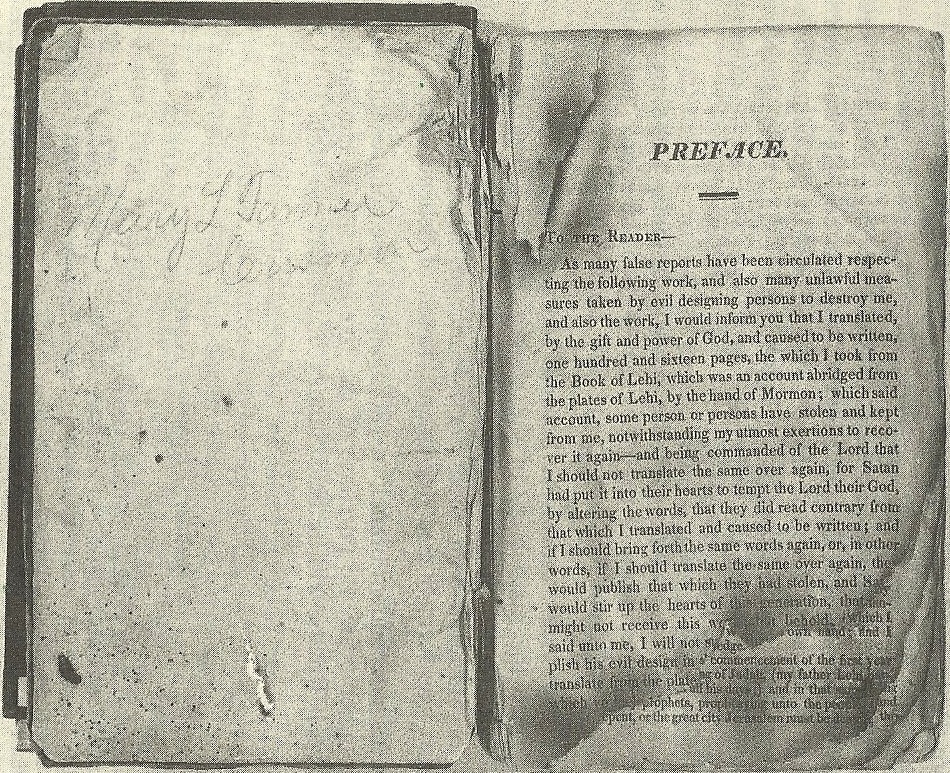
Someone saved John Tanner's original copy of the Book of Mormon from the fire, although it suffered significant damage.

John Tanner's original Book of Mormon. When George Tanner wrote the book John Tanner and His Family, this original copy of the Book of Mormon was in the possession of Patience Thatcher of Logan, Utah. From John Tanner and His Family (Tanner, 1974), page 44.

If the daguerreotype was taken before 1847, was it rescued from the fire? Does it have any evidence of fire damage? Was it rescued without damage? Or was the picture taken later?

Sixty-nine year old John Tanner and his family left Winter Quarters on July 3, 1848. They arrived in the Salt Lake Valley in the middle of October 1848 and settled in South Cottonwood (now Murray), in the Salt Lake Valley.

John Tanner died a year and a half later. I have not seen any suggestion of a daguerreotypist operating in Salt Lake City before John Tanner's death on April 13, 1850. The first daguerreotypist in Salt Lake City seems to have been Marsena Cannon, Sr. He and his family arrived in Salt Lake City on October 14, 1850, six months after John Tanner's death.

The year after John Tanner's death, his family left South Cottonwood to go to San Bernardino with Charles C. Rich and Amasa Lyman. They were in San Bernardino until 1858, when they returned to Utah Territory at the time of the Mormon conflict with the Federal Government.

Subsequent posts will discuss the identity of the people in the picture, the possibility that it was taken in San Bernardino, and the possible dates for the picture.

To be continued...

Part 1: Introduction
Part 2: We Meet the Tanners
Part 3: What is a Daguerreotype?
Part 4: Technology Meets the Tanners
Part 5: Woman at Right
Part 6: Woman in Center
Part 9: Summary

Wednesday, March 7, 2012

The Tanner Family Daguerreotype: What is a Daguerreotype?

The history of photography is too complicated to describe here, but the first photographic images of people were created in 1838 or 1839, just a few years before the Tanner daguerreotype was taken. It was a technology whose time had come: it quickly became widespread within a few years.

Here is the picture of the first known photographic image that shows living people. The picture was taken with a ten-minute exposure, so the only people who show up are a man getting his shoes polished, and the shoe-shine boy, who didn't move for much of that time. (Look in the bottom left corner.)

From Wikipedia.

This picture was created by Frenchman Louis Daguerre, the man who developed the process known as daguerreotype. There were many other processes being developed about the same time; William Henry Fox Talbot made major contributions to the technology.

The daguerreotype process is complicated:
The daguerreotype is a direct-positive process, creating a highly detailed image on a sheet of copper plated with a thin coat of silver without the use of a negative. The process required great care. The silver-plated copper plate had first to be cleaned and polished until the surface looked like a mirror. Next, the plate was sensitized in a closed box over iodine until it took on a yellow-rose appearance. The plate, held in a lightproof holder, was then transferred to the camera. After exposure to light, the plate was developed over hot mercury until an image appeared. To fix the image, the plate was immersed in a solution of sodium thiosulfate or salt and then toned with gold chloride.
Exposure times for the earliest daguerreotypes ranged from three to fifteen minutes, making the process nearly impractical for portraiture. Modifications to the sensitization process coupled with the improvement of photographic lenses soon reduced the exposure time to less than a minute.
Although daguerreotypes are unique images, they could be copied by redaguerreotyping the original. Copies were also produced by lithography or engraving. ("The Daguerreotype," Library of Congress.)
A daguerreotype was taken by a camera with the lens in a sliding compartment. The daguerreotype artist focused the picture by sliding the rear compartment of the box forward or backward. The daguerreotype was a mirror image unless the image was flipped by a mirror or prism. The artist took the picture by putting a plate into the camera, and then removing the lens cap to expose the plate.

Daguerreotypes came in several standard sizes:
Whole plate            6.5 x 8.5 inches
Half plate                4.25 x 5.5 inches
Quarter plate           3.25 x 4.25 inches
Sixth plate               2.75 x 3.25 inches
Ninth plate              2 x 2.5 inches
Sixteenth plate        1.375 x 1.625 inches
A daguerreotype was typically placed in a case and a brass protector, then covered with glass, a brass mat, and a paper seal. (Christopher Warren.)

Early British daguerreotype. By whatsthatpicture from www.flickr.com/photos/whatsthatpicture/5974940963/.

Here is a good resource about daguerreotypes:
America's First Look into the Camera: Daguerreotype Portraits and Views, 1839-1862 (Library of Congress)

To be continued...

Part 1: Introduction
Part 2: We Meet the Tanners
Part 3: What is a Daguerreotype?
Part 4: Technology Meets the Tanners
Part 5: Woman at Right
Part 6: Woman in Center
Part 7: Boy in Back — First Possibility
Part 7: Boy in Back — Additional Possibilities
Part 8: Man at Left — John Tanner?
Part 8: Man at Left — Options
Part 9: Summary